
Radon-Resistant New Construction in Spokane and North Idaho
Washington has required radon-resistant building in Spokane County since July 1991, and since March 2024 the code adds a radon test once the house is built. We plan the gravel, membrane and pipe with your builder and test at the end.
Or call (509) 278-2215
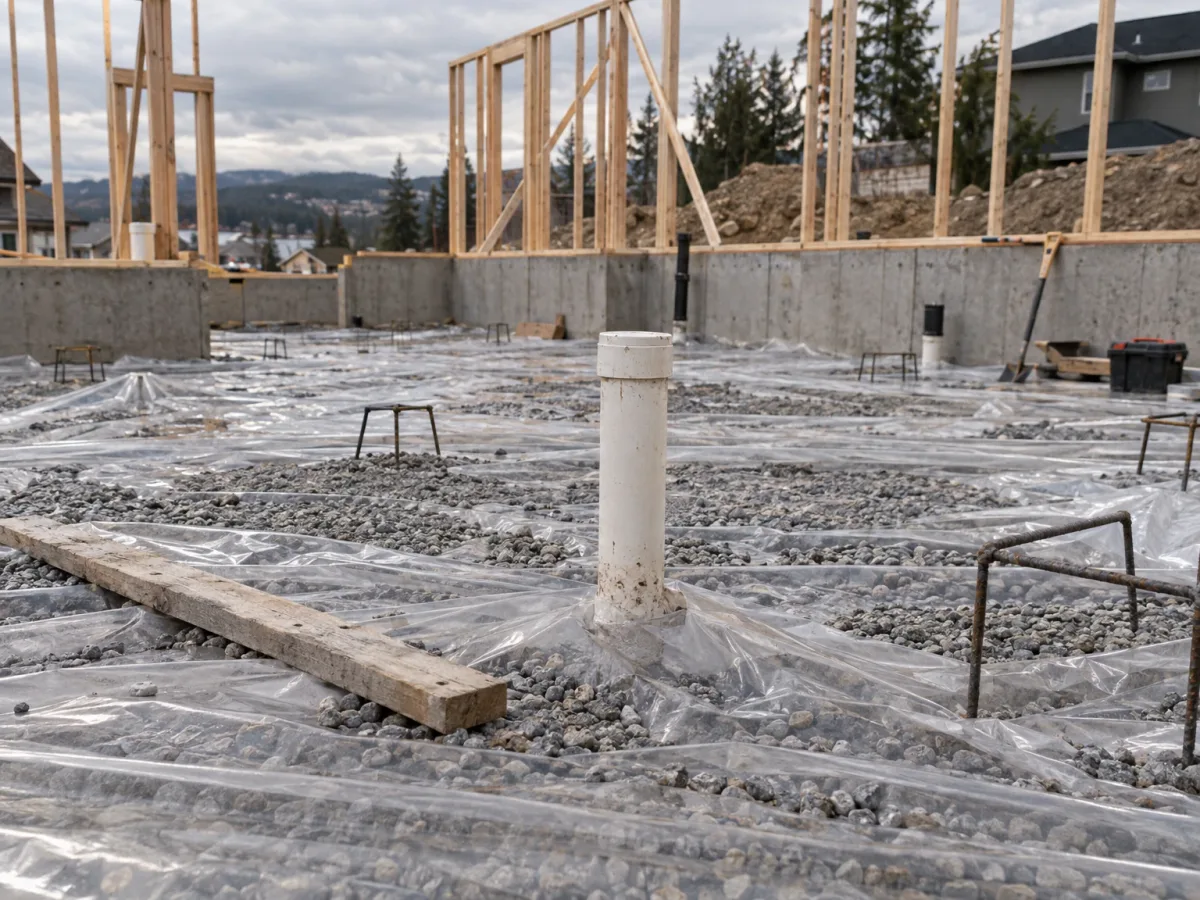
When this service fits
This service is for builders, owner-builders and buyers of new homes in Spokane and Kootenai counties. In Washington the radon features belong to the permit for a new house or a habitable addition.
In Idaho they are optional, and the build is still the easiest moment to add them: gravel, membrane and pipe all go in before the slab closes the ground.
- You are planning a new house or a habitable addition in Spokane County
- The foundation combines slabs, a basement or a crawl space
- You build in Kootenai County and want the pipe in from the start
- The test after completion reads 4 pCi/L or higher
- You bought a new home and want to know what the builder installed
Working with builders, step by step
- STEP 1
Plan check
We go through the foundation plan and mark each gravel area, the membrane and the pipe route. Every separate gravel area needs its own pipe or a 3-inch connection for each 30 feet of barrier.6
- STEP 2
Pipe route and fan location
The vent pipe should rise through the heated part of the house and leave through the roof. We mark where a fan would sit and where the electrician sets the junction box.21
- STEP 3
Check before the slab is poured
Before the pour we check the clean gravel layer of at least 4 inches, the soil-gas membrane and the pipe tee set in the gravel.6
- STEP 4
Seal and label
Slab joints, cracks and pipe penetrations get sealed. The pipe gets a “RADON VENT” label on every floor and in the attic.6
- STEP 5
Test after the air-tightness test
Once the radon parts and the HVAC system are in, the house is tested for at least 48 hours on the lowest occupied floor. Windows and doors stay closed for 12 hours before the test starts.5
- STEP 6
Fan and retest where needed
At 4 pCi/L or more, we install the fan on the existing pipe and adjust the system until a retest reads below 4.5
- STEP 7
Report for the code official
The written result below 4 pCi/L goes to the code official. The owner gets a copy for the home’s records.5
What building it in costs
EPA puts the economics in one sentence: “The cost to the builder of including these features is typically less than the cost to mitigate the home after construction.”
We price each build after the plan check. The number of separate slabs, a crawl space membrane, the length of the pipe run and whether the test calls for a fan decide the work.
Unincorporated Spokane County: Building & Planning, 1026 W Broadway Ave, 1st Floor, (509) 477-3675. Inside a city, that city’s building office handles the radon parts.
What Washington requires in Spokane County
Section R332 of the Washington residential code applies Appendix F to buildings constructed in the high radon potential counties of Table AF101(1): Clark, Ferry, Okanogan, Pend Oreille, Skamania, Spokane and Stevens. The state text says the techniques are meant “to resist radon entry and prepare the building for post-construction radon mitigation, if necessary.”
Spokane County spells out the details in its handout BP-12: at least 4 inches of clean aggregate under each slab, a 10-mil polyethylene retarder with 12-inch laps, and a gas-tight pipe at least 3 inches across. The pipe ends at least 12 inches above the roof and 10 feet from any opening, with a 110-volt junction box near its top.1, 2, 3, 6
The test-and-activate rule since March 2024
Washington’s 2021 residential code took effect on March 15, 2024. Its radon appendix adds section AF104: where radon-resistant construction is required, the finished house is tested before the final report goes to the code official.
The test runs at least 48 hours with the HVAC operating, never in a closet, hallway, bathroom or kitchen. The builder, a registered design professional or an approved third party may run it with two averaged test kits or a continuous radon monitor.4, 5
Idaho: no state rule, so check the city
Idaho’s state code adopts Parts I, II, III and IX of the 2018 IRC and names none of its appendices, so the radon appendix does not apply. Idaho’s health department says these methods “are not required by law in Idaho unless a city or county has specifically adopted them into their local building codes.”
Coeur d’Alene’s city code adopts the 2018 IRC with Appendices J, K and Q only, and Hayden’s with J and K. Kootenai County’s building code ordinance, in force since January 1, 2025, adds the patio cover and tiny house appendices, not the radon one. Post Falls lists the 2018 IRC without naming an appendix; for Rathdrum we found no published list.
The answer matters for new housing. In Post Falls and Rathdrum the median home was built in 2005.14, 15, 16, 17, 18, 19, 20, 22, 24
Spokane County and Kootenai County side by side
| Spokane County, WA | Kootenai County, ID | |
|---|---|---|
| Radon features in new homes | Required by R332 and Appendix F | Not required by the state |
| Test once the house is built | Required since March 15, 2024 | Not required |
| Fan at 4 pCi/L or more | Required, then a retest | The owner’s choice |
Source 5.
Which office checks it
Washington’s building code “shall be enforced by the counties and cities,” so the office that issues your building permit also handles the radon parts. Contacts and rules as of October 2026; general information, not legal advice.
Unincorporated Spokane County
Spokane County Building & Planning, 1026 W Broadway Ave, 1st Floor, (509) 477-3675. Its handout BP-12 lists the radon details for new homes.9
City of Spokane
The city handles its own building permits. Its single-family application asks which radon mitigation method you use, and on-grade habitable additions need one too.10
Spokane Valley
The Permit Center at City Hall, 10210 E Sprague Ave, (509) 720-5240, issues building permits for plans drawn to the 2021 IRC.12
Liberty Lake
The permit checklist asks for confirmation that the prescriptive method will be installed, or a letter from a certified mitigator.13
Apartments
Group R buildings under the commercial code follow WAC 51-50-1202, Section 1202.7.23
Questions
Can a brand-new home still test high?
Yes. Washington’s code describes the features as a way to resist radon entry and to prepare the house for a fan if one is needed, not as a promise of a low reading. That is why the 2021 code asks for a test once the house is finished.
Does a new home in Spokane County have to be tested for radon?
Yes, for homes built under the current code. Since March 15, 2024, the radon appendix of the 2021 IRC applies in Spokane County: a test of at least 48 hours after the air-tightness test, and a written result below 4 pCi/L for the code official.
Is radon-resistant construction required in Coeur d’Alene or Post Falls?
Not by Idaho law, and Coeur d’Alene’s city code leaves the radon appendix out. Post Falls names the 2018 IRC without listing an appendix, so its building division at (208) 773-8708 is the place to confirm before you plan a lot.
What do radon-resistant features add to a build?
Idaho’s Department of Health and Welfare estimates $300–$500 for the features and says they are “easiest to install during construction.” We quote a build once the foundation plan is clear.
Does the rule apply to an addition?
Spokane County applies it to residential additions as well as new homes, but not to the existing part of the house. The City of Spokane’s guide for additions says radon mitigation is required for habitable additions on grade.
Sources (25)
- Washington State Legislature, WAC 51-51-0332, Section R332 Protection against radon (2020)
- Washington State Legislature, WAC 51-51-60101, Appendix F, Table AF101(1) (2007)
- Washington State Legislature, WAC 51-51-60103, Section AF103.1 (2024)
- Washington State Legislature, WAC 51-51-003, International Residential Code 2021 adopted, effective March 15, 2024
- International Code Council, International Residential Code 2021, Appendix F, Section AF104 Testing (reproduced by SOS Radon)
- Spokane County Building & Planning, BP-12 Radon Control for High Radon Potential (2025)
- AARST International Radon Symposium, Washington’s Radon Construction Standards, K. A. Coleman, WA Department of Health (1993)
- Washington State Legislature, RCW 19.27.050 Enforcement
- Spokane County, Building & Planning, contact (2026)
- City of Spokane, New Single-Family Residence & Duplex application (2021)
- City of Spokane, Residential Addition EDR guide sheet (2020)
- City of Spokane Valley, Residential Construction Permit Application and submittal checklist
- City of Liberty Lake, Building Permit Checklist
- Idaho State Legislature, Idaho Code § 39-4109, Application of codes (2022)
- Idaho Building Code Board, IDAPA 24.39.30, Rules of Building Safety (2024)
- Idaho Department of Health and Welfare, Radon (2026)
- Kootenai County, Ordinance No. 608, Building Code Ordinance Amendments (effective January 1, 2025), § 7.1.201(B)
- City of Coeur d’Alene, City Code 15.08.005 International building codes; adoption (Ord. 3669, 2020)
- City of Hayden, City Code 9-1-1 Codes adopted (Ord. 616, 2020)
- City of Post Falls Building Division, Current Adopted Codes and Design Criteria (rev. 2025)
- U.S. EPA, Radon-Resistant Construction Basics and Techniques (2026)
- U.S. Census Bureau, American Community Survey 2020–2024, Table B25035 Median Year Structure Built (via Census Reporter)
- Washington State Legislature, WAC 51-50-1202, Section 1202.7 Radon resistive construction standards (2024)
- International Code Council, 2018 International Residential Code, Section R102.5 Appendices (Idaho edition)
- City of Spokane Valley: Permit Center