
Radon Mitigation in Post Falls, ID
Post Falls climbs north from the Spokane River in a series of Ice Age flood terraces, each a gravel bed tens to hundreds of feet thick. Idaho DHW test results by ZIP code, updated through 2019, list 2,047 home radon tests for 83854, and 1,146 of them, 56%, reached 4.0 pCi/L or more. Most homes here went up after 2000.
Or call (509) 278-2215
48-hour test from $195 · Systems from $1,295 · Post-mitigation test included
How it works in Post Falls
- STEP 1Test
A 48-hour continuous monitor in your lowest living level, under closed-house conditions. Report the same day it comes out.
- STEP 2Look and quote
We check the foundation, run a suction test and plan the pipe route for Post Falls winters. You get a fixed price in writing.
- STEP 3Install
Most systems take one day: suction point, sealing, fan, manometer and the electrical permit.
- STEP 4Re-test
A post-mitigation test at least 24 hours after the fan starts shows the new number. The guarantee is below 4.0 pCi/L.
Radon mitigation cost in Post Falls
On the prairie terraces, coarse gravel under a slab usually carries suction a long way. Homes on the south-side hills, with clayey soil close under the surface, may need more than one point. The city's electrical permit, $67 with one circuit included, is part of our price, and Avista or Kootenai Electric bills the fan depending on your address.
Starting prices include the electrical permit and the post-mitigation test. Bold: systems common in Post Falls homes. Estimate your system →
- Habitat for Humanity of North Idaho, home repair (radon not named, ask): Health and safety repairs for owners up to 80% of the area median income, who help with the work. 208-762-4663
for a typical 60-watt fan running around the clock, depending on which utility serves your address. Energy charge only, at 2026 residential rates.
A 20-watt fan costs about a third of that, a 90-watt fan half again as much.
When and how to test in Post Falls
If 56% of tests in 83854 reached 4.0 pCi/L or more, 44% came in under it. A house on the low Beck Road terrace and one up on Ross Point share a ZIP code, not a reading. Test the lowest room you live in, with the house closed up, and go by your result rather than the map.
The Idaho DHW free kit, one per address every two years, was out of stock in October 2026, and the state's library lending program has no site in Kootenai County. Kits from National Radon Program Services cost $20 for a short-term test and $30 for a long-term one. Panhandle Health District, the local health department, has no radon program.
Buying a home here on a deadline? A 48-hour continuous monitor gives a result within days, and a tamper-resistant setup is made for sales. The EPA's guidance is to fix at 4.0 pCi/L or higher and to think about fixing between 2 and 4.
Permits and local rules in Post Falls
Post Falls runs its own electrical permits and inspections through its Building Division. For an existing home the fee is $67, one circuit included, plus $10 for each additional branch circuit (fee schedule revised October 1, 2026).4
The city's design criteria set frost depth at 24 inches and the ground snow load at 56 psf, with a 40 psf roof snow load. A radon pipe's roof exit and any outdoor run are planned for that winter.5
Idaho adopts the 2018 International Residential Code for houses without its radon appendix. No statewide rule requires radon-resistant construction.11
Radon appears nowhere on Idaho's statutory seller disclosure form; the nearest item asks whether the seller knows of hazardous materials or pests. A recent test answers what the form leaves open.14
Post Falls at a glance
Area figures describe the neighborhood, not your home. Only a test tells you your number. Sources are listed at the end of this page.
A staircase of flood gravel
North of the river, Post Falls stands on Rathdrum Prairie gravel roughly 500 to 600 feet thick. The Idaho Geological Survey maps it as mostly boulder gravel with beds of sand, topped unevenly by loess and volcanic ash and cemented in places with calcium carbonate. The floods that laid it down also cut it into a series of terraces.
The lowest step, the Gravel of Beck Road, lies near the state line at about 2,100 feet. Next comes McGuire at 2,140 feet, 80 to 100 feet thick, then the coarse, poorly sorted Green Ferry gravel at about 2,200 feet, over 100 feet thick. Ross Point is highest, near 2,340 feet, more than 150 feet thick and with the best-developed soil.
South of the river the city meets different rock. Toward Blossom Mountain the hills are old gneiss, schist and quartzite that weather to sandy silt, and gentle slopes carry 3 to 6 feet of loess and ash over a clayey buried soil 10 to 20 inches down. Granite cliffs line the river in the city's Community Forest. Terrace, hillside or riverbank, no lot predicts the radon of the next one.
of Rathdrum Prairie gravel under the north side of Post Falls, mostly boulder gravel with sand beds6
From Frederick Post's mill to new subdivisions
Frederick Post arrived in 1871 and used the river's 'Little Falls' to power the area's first commercial lumber mill. Dams have closed the three natural channels at the falls since 1906, and they now control the outflow and summer level of Coeur d'Alene Lake. On the farms around town, grass seed replaced beans in the 1950s.
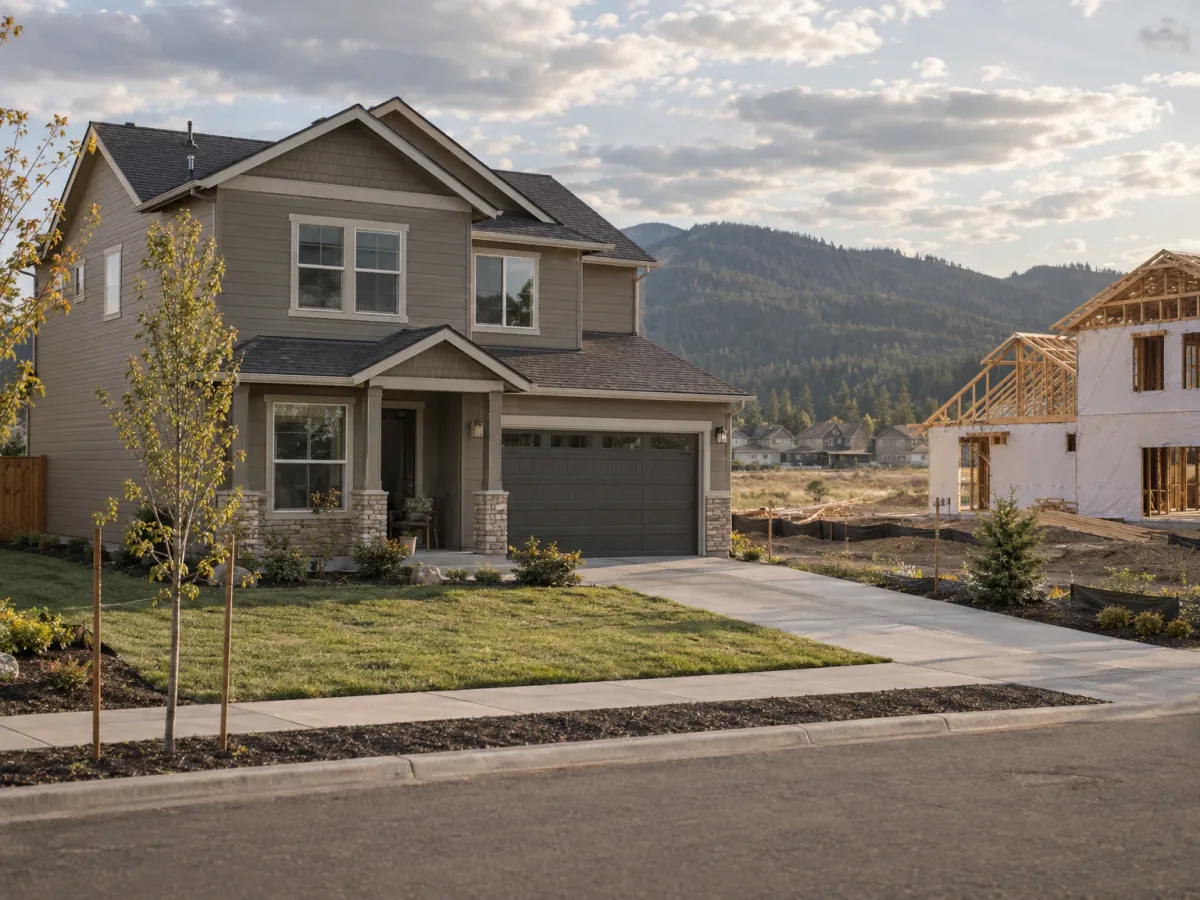
The houses are much younger than the town. The median Post Falls home was built in 2005, and only about 16% are older than 1980. Between April 2020 and July 2024 the population grew an estimated 19%, and the city's 2025 housing needs analysis called for nearly 2,400 new units within five years.
No statewide rule asked builders to add radon-resistant features, so whether a newer Post Falls home has a passive pipe is up to its builder. If it has one, a fan may be most of the job; if not, a full sub-slab system goes in.
Share of homes by year built. Source 2.
Post Falls questions
Does Post Falls issue its own electrical permit for a radon fan?
Yes. The city's Building Division has handled electrical permits since 2015; for an existing home it costs $67 with one circuit, plus $10 per added circuit, and it is included in our price.
How many Post Falls homes test high for radon?
Of 2,047 home tests in ZIP 83854 in Idaho DHW data, 1,146 were at or above 4.0 pCi/L. That is 56%, so your house could fall on either side.
My Post Falls house is less than ten years old. Could it have radon?
Yes. Idaho doesn't require radon-resistant construction statewide, and a new house sits on the same gravel as an old one.
Does the terrace my house is on matter?
The terraces differ in height, thickness and coarseness, and the south-side hills are weathered rock with clayey soil. That changes how suction spreads under a floor, which is why a pressure-field test comes before the quote.
What does running the fan cost in Post Falls?
For a 60-watt fan, about $55 to $61 a year at Kootenai Electric, depending on the rate option, or $67 at Avista's October 2026 Idaho rate. A 20-watt fan costs about a third of that.
Do Post Falls winters change how the system is installed?
The city designs for 24 inches of frost and a 56 psf ground snow load. The pipe route and roof exit are chosen with snow and ice in mind.
ZIP codes: 83854 · 83877
Sources for Post Falls (20)
- Idaho Department of Health and Welfare: Home radon test results by ZIP code (updated through 2019)
- U.S. Census Bureau: American Community Survey 2020–2024, Post Falls city (tables B25034, B25035)
- U.S. Census Bureau: City and town population estimates for Idaho, Vintage 2024
- City of Post Falls: Building fee schedule (revised October 1, 2026)
- City of Post Falls: Current adopted codes and design criteria
- Idaho Geological Survey: Surficial Geologic Map of the Post Falls Quadrangle (SGM-5)
- City of Post Falls: Post Falls Community Forest, history and future plans
- Kootenai County: Comprehensive Plan, Chapter 3, History and Special Sites
- U.S. Geological Survey: Surficial Geology along the Spokane River, Washington (Open-File Report 02-126)
- City of Post Falls: City Council reviews Housing Needs Analysis report (March 19, 2025)
- IDAPA 24.39.30: Idaho Rules of Building Safety (building code adoption)
- Avista Utilities: Idaho electric schedule summaries, effective October 1, 2026
- Kootenai Electric Cooperative: Summary of rates, effective June 1, 2026
- Idaho Code § 55-2508: Seller property disclosure form
- Idaho Department of Health and Welfare: Radon air test (short-term), DHW health tools shop
- Idaho Department of Health and Welfare: What is radon? (Idaho Radon Program)
- National Radon Program Services (Kansas State University): Radon test kits
- Panhandle Health District: Website search for radon (no results, October 2026)
- U.S. EPA: What is EPA's action level for radon?
- City of Post Falls: Building Division
Find your number in Post Falls.
48-hour test from $195. Mitigation from $1,295 with the post-test included.