
Radon Mitigation in Coeur d'Alene, ID
Coeur d'Alene grew where the Spokane River drains out of Coeur d'Alene Lake, and its two main ZIP codes don't test alike. In Idaho DHW results by ZIP code, updated through 2019, 46% of 1,328 home tests in 83814 and 52% of 1,928 in 83815 reached 4.0 pCi/L or more. Shoreline, prairie and hillside lots each sit on different ground.
Or call (509) 278-2215
48-hour test from $195 · Systems from $1,295 · Post-mitigation test included
How it works in Coeur d'Alene
- STEP 1Test
A 48-hour continuous monitor in your lowest living level, under closed-house conditions. Report the same day it comes out.
- STEP 2Look and quote
We check the foundation, run a suction test and plan the pipe route for Coeur d'Alene winters. You get a fixed price in writing.
- STEP 3Install
Most systems take one day: suction point, sealing, fan, manometer and the electrical permit.
- STEP 4Re-test
A post-mitigation test at least 24 hours after the fan starts shows the new number. The guarantee is below 4.0 pCi/L.
Radon mitigation cost in Coeur d'Alene
Here the house drives the price more than the ground. An old bungalow with a basement and a later addition on its own foundation can need two suction points, while a newer slab on prairie gravel often needs one. Avista or Kootenai Electric powers the fan, depending on where you live.
Starting prices include the electrical permit and the post-mitigation test. Bold: systems common in Coeur d'Alene homes. Estimate your system →
- Coeur d'Alene Emergency Minor Home Repair (EMRAP): Grants up to $5,000 for low- and moderate-income owners inside city limits; the city lists radon mitigation systems among its typical projects. 208-769-2382
- Habitat for Humanity of North Idaho, home repair (radon not named, ask): Health and safety repairs for owners up to 80% of the area median income, who help with the work. 208-762-4663
for a typical 60-watt fan running around the clock, depending on which utility serves your address. Energy charge only, at 2026 residential rates.
A 20-watt fan costs about a third of that, a 90-watt fan half again as much.
Getting a Coeur d'Alene radon number
Put the test in the lowest room you actually use, with windows and doors shut, ideally in the heating season. In both city ZIP codes roughly half of reported tests reached 4.0 pCi/L, which also means roughly half did not. Living in 83815 or 83814 says nothing certain about your own house; the test does.
Idaho DHW normally mails one free short-term kit per address every two years, but its shop listed the kit as sold out in October 2026. Its fallback, a library lending program, has no library in Kootenai County. National Radon Program Services at Kansas State University sells a short-term kit for $20, delivered in one to two weeks.
When a closing date is set, a 48-hour continuous monitor is quicker, and its report shows how the level moved hour by hour. EPA guidance is to fix a home at 4.0 pCi/L or higher and to consider fixing between 2 and 4.
Permits and local rules in Coeur d'Alene
Coeur d'Alene's building fee list, updated August 4, 2026, covers building, mechanical and plumbing permits but no electrical ones. The permit for the fan circuit therefore comes from the state, through the Idaho Division of Occupational and Professional Licenses (DOPL).11
Idaho's residential code adopts the core parts of the International Residential Code but not its radon appendix, and Coeur d'Alene's city code adds only Appendices J, K and Q. Radon-resistant construction is not required here, so a passive pipe is up to the builder.19
Idaho's statutory seller disclosure form never mentions radon. Question 7 asks about hazardous materials or pest infestations, and the form itself says it is no substitute for inspections.13
Federal utility data list Avista, Kootenai Electric, Northern Lights and Inland Power in Kootenai County. In Coeur d'Alene it is Avista or Kootenai Electric, depending on the address; your bill tells you which.14
Coeur d'Alene at a glance
Area figures describe the neighborhood, not your home. Only a test tells you your number. Sources are listed at the end of this page.
Lake, prairie and hillside ground
The Ice Age floods left a deposit here that the Idaho Geological Survey names after the city: the Gravel of Coeur d'Alene, 20 to 80 feet of cobbly sand and sandy gravel. Some of it came with the floods and some with water pushing back out of the lake afterward. Seismic surveys still find giant current ripples of this gravel on the lake floor between Tubbs Hill and North Cape.
Ground changes quickly from there. Newer subdivisions to the north spread onto the Rathdrum Prairie. Around the lake basin, basalt rimrock and clay of the Latah Formation take over, including a clay deposit on Blackwell Hill, and below the rims lie slopes of angular basalt mixed with silt and clay up to 40 feet thick. In the uplands, the soil is weathered granodiorite, tonalite and gneiss.
U.S. Geological Survey work on the aquifer finds that near Coeur d'Alene it is bounded by basalt and fine-grained layers rather than crystalline rock, and that the shallowest water on the Idaho side lies near the outlets of Coeur d'Alene and Hayden lakes. With gravel, clay and weathered rock this close together, a house's own test is the only number that counts.
of flood-laid cobbly sand and gravel in the Gravel of Coeur d'Alene, the deposit named for the city4
Fort Sherman bungalows to prairie subdivisions
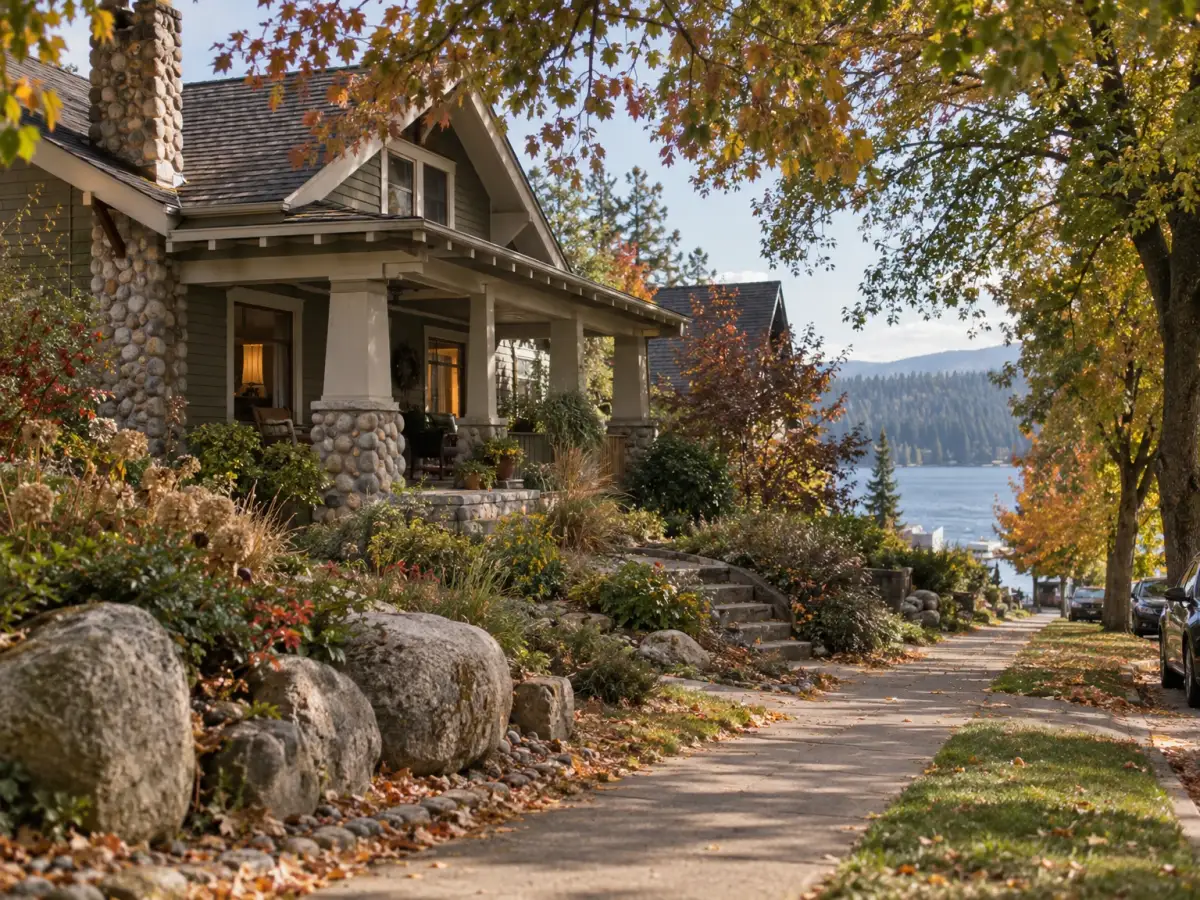
The town grew at the edge of Fort Coeur d'Alene, founded in 1878 and later called Fort Sherman, as a supply point for mining and timber. It became county seat in 1908 and had about 8,000 people and six large lumber mills by 1910. The first neighborhoods spread north into the Garden District and west into the Fort Grounds, mostly wood-frame bungalows and foursquares.
After World War II, building moved north and west on curving streets and larger lots, Sunset Heights first and Monte Vista in the 1970s and 1980s, and apartments and condos took off in the 1980s. About 2,260 homes still standing were built in 1939 or earlier. The Garden District joined the National Register of Historic Places in April 2025.
Old foundations here were poured long before anyone planned for radon, and newer ones aren't covered by a statewide radon rule either. About 41% of the city's homes date from 2000 or later, and roughly one in three is something other than a detached house, so condo and apartment owners should test the lowest occupied floor.
Share of homes by year built. Source 2.
Coeur d'Alene questions
Which Coeur d'Alene ZIP code has more high radon tests?
Idaho DHW data show 52% of 1,928 tests at or above 4.0 pCi/L in 83815 and 46% of 1,328 in 83814. The gap is small, and in both ZIP codes plenty of homes tested low and plenty tested high.
Who issues the electrical permit for a radon fan in Coeur d'Alene?
The city's fee list has no electrical permits, so it comes from the state through Idaho DOPL. The permit is part of the price we quote.
Can an older Garden District or Fort Grounds home get a radon system?
Yes. Older foundations often need more crack sealing and a carefully chosen pipe route, which we plan after a pressure-field test and before the quote.
Did my newer Coeur d'Alene home come with a radon pipe?
Only if the builder added one, since Idaho's statewide code leaves out the radon appendix. Look for a labeled pipe rising from the basement floor or slab; if you find one, a fan can make it active.
What does the radon fan add to my power bill?
A 60-watt fan uses about 526 kWh a year: roughly $55 to $61 at Kootenai Electric, depending on the rate option, and $67 at Avista's October 2026 Idaho rate.
Where can I get a radon test kit in Coeur d'Alene?
Idaho DHW's free kit was sold out in October 2026, and no Kootenai County library lends radon kits under the state program. Low-cost kits are sold by mail, or you can book a 48-hour monitor test.
ZIP codes: 83814 · 83815 · 83816
Sources for Coeur d'Alene (19)
- Idaho Department of Health and Welfare: Home radon test results by ZIP code (updated through 2019)
- U.S. Census Bureau: American Community Survey 2020–2024, Coeur d'Alene city (tables B25034, B25035, B25024)
- U.S. EPA: Map of radon zones, Idaho (1993)
- Idaho Geological Survey: Surficial Geologic Map of the Coeur d'Alene Quadrangle (SGM-7)
- U.S. Geological Survey: Hydrogeologic Framework of the Spokane Valley–Rathdrum Prairie Aquifer (SIR 2007-5041)
- Kootenai County: Comprehensive Plan, Chapter 3, History and Special Sites
- City of Coeur d'Alene: Historic Preservation Plan (December 2021)
- City of Coeur d'Alene: Historic Preservation Commission
- Avista Utilities: Idaho electric schedule summaries, effective October 1, 2026
- Kootenai Electric Cooperative: Summary of rates, effective June 1, 2026
- City of Coeur d'Alene: City-wide fee list, building (updated August 4, 2026)
- IDAPA 24.39.30: Idaho Rules of Building Safety (building code adoption)
- Idaho Code § 55-2508: Seller property disclosure form
- U.S. Energy Information Administration: EIA-861 utility data, 2024
- Idaho Department of Health and Welfare: Radon air test (short-term), DHW health tools shop
- Idaho Department of Health and Welfare: What is radon? (Idaho Radon Program)
- National Radon Program Services (Kansas State University): Radon test kits
- U.S. EPA: What is EPA's action level for radon?
- City of Coeur d’Alene, City Code 15.08.005 International building codes; adoption (Ord. 3669, 2020; current through Ord. 3779, July 7, 2026)
Find your number in Coeur d'Alene.
48-hour test from $195. Mitigation from $1,295 with the post-test included.