
Radon Mitigation in Latah Valley
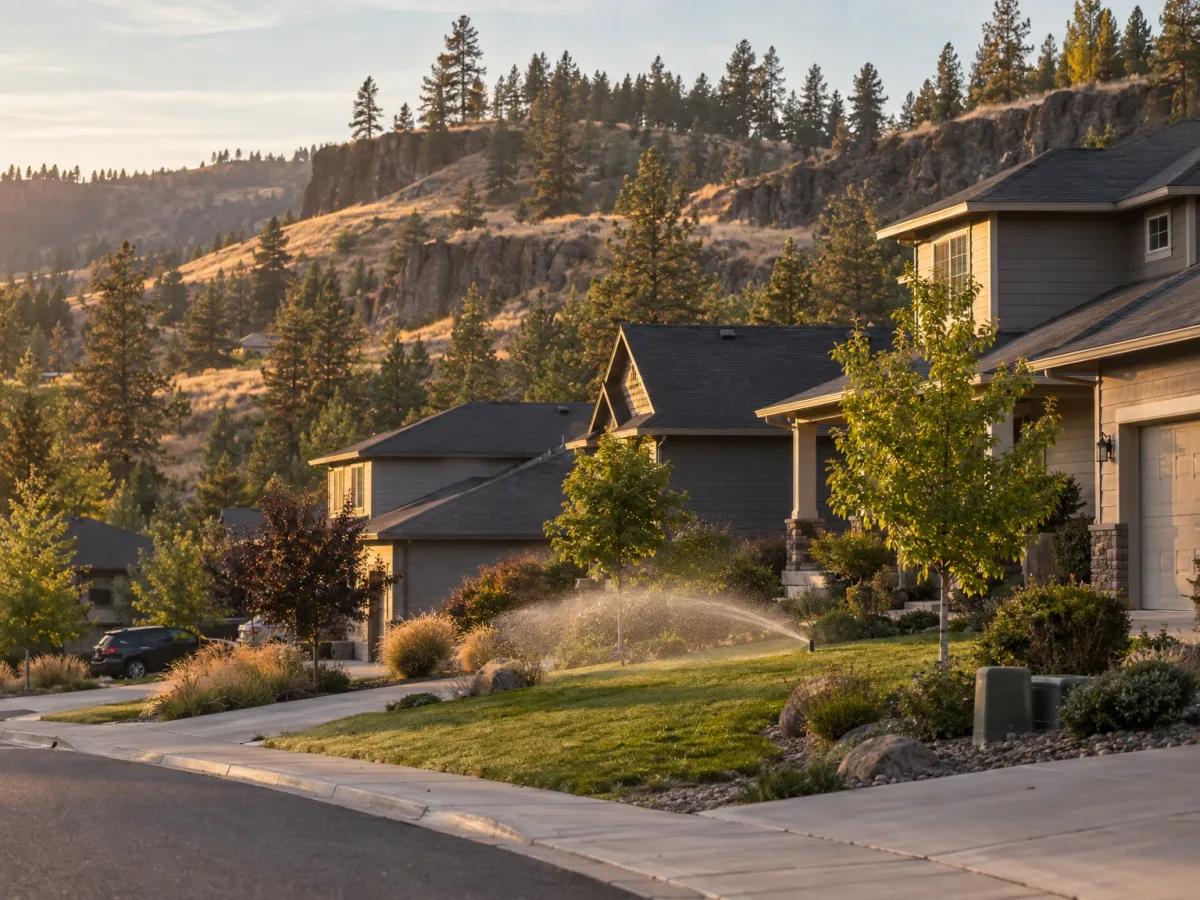
Latah Valley gave its name to the Latah Formation, a soft lake-bed clay and shale. Along Latah (Hangman) Creek it mixes with glacial lake silt, flood sand and old landslide debris. State test records here run below the county's, and no census tract reaches half, but the highest comes close. The valley also straddles the city line, which decides who permits the work.
Or call (509) 278-2215
48-hour test from $195 · Systems from $1,295 · Post-mitigation test included
How it works in Latah Valley
- STEP 1Test
A 48-hour continuous monitor in your lowest living level, under closed-house conditions. Report the same day it comes out.
- STEP 2Look and quote
We check the foundation, run a suction test and plan the pipe route for Latah Valley winters. You get a fixed price in writing.
- STEP 3Install
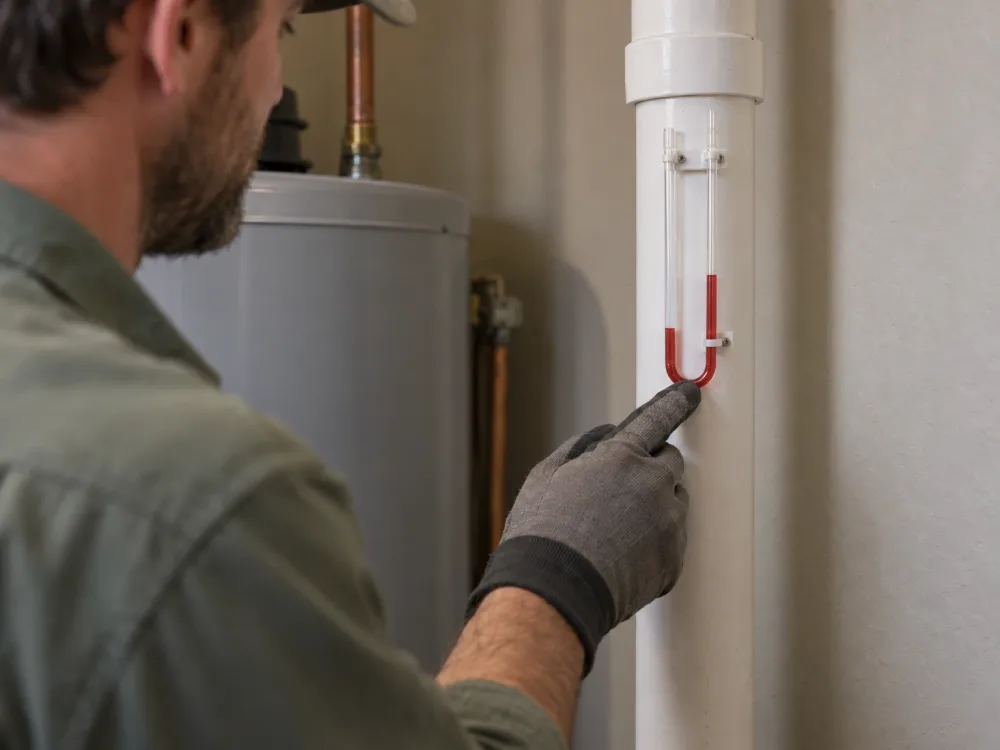
Most systems take one day: suction point, sealing, fan, manometer and the electrical permit.
- STEP 4Re-test
A post-mitigation test at least 24 hours after the fan starts shows the new number. The guarantee is below 4.0 pCi/L.
Radon mitigation cost in Latah Valley
A builder's passive pipe is the cheapest starting point: activating it is the lowest-priced system on our list. Older creek-side houses, and slabs on clay or slide debris, get a pressure-field test first, since suction can spread unevenly in mixed ground. Inside city limits the fan runs on Avista power; outside them, check which utility bills you.
Starting prices include the electrical permit and the post-mitigation test. Bold: systems common in Latah Valley homes. Estimate your system →
- City of Spokane Minor Home Repair (run by SNAP) (radon not named, ask): Free or low-cost health and safety repairs for owners inside city limits with income under 80% of the area median. 509-456-7627
- Spokane County Minor Home Repair (run by SNAP) (radon not named, ask): Repairs of immediate health and safety hazards for lower-income owners outside Spokane city limits. 509-456-7627
- USDA Section 504 Home Repair (radon not named, ask): 1% loans up to $40,000, and grants up to $10,000 for owners 62 or older, for very low incomes in eligible rural areas. USDA's map splits Latah Valley: Eagle Ridge and Qualchan lie outside the eligible area, homes further south toward Marshall inside it. Check your address. 509-381-6722
for a typical 60-watt fan running around the clock. Energy charge only, at 2026 residential rates.
A 20-watt fan costs about a third of that, a 90-watt fan half again as much.
Testing in Latah Valley and on Moran Prairie
Next-door houses here can sit on lake silt, flood sand, slide debris or clay, so a neighbor's number is a poor guide. Test the lowest level you use, with the house shut, ideally in the colder months.
The state health department's free kits are limited, and one takes 8 to 10 weeks to arrive. A 48-hour continuous monitor is faster when a sale or a remodel sets the deadline.
On a private well outside the city? The Spokane Regional Health District says some county wells have elevated uranium or arsenic and recommends that owners test. For the air, EPA's line is 4.0 pCi/L, with a fix worth considering from 2 to 4.
Permits and local rules in Latah Valley
Addresses within Spokane city limits get their electrical permit from the city, not the state. The city prices it at $7.20 per circuit in existing space for 2026 and publishes no base fee.13
In unincorporated Spokane County, home to 43.4% of the ZIP's 2020 residents, Washington L&I issues electrical permits: $78.80 covers up to four circuits, $8.20 each after that (July 2026).14
City and county both design for frost 24 inches deep and a 39 psf ground snow load. The county sets site-specific values from its snow-load maps, and the city requires at least 30 psf on roofs.16
Appendix F of the state residential code applies in Spokane County, so new homes in Qualchan and Eagle Ridge must include radon controls meant to resist entry and make a later fix easier.11
About 15 minutes from our shop.
Latah Valley at a glance
Area figures describe the neighborhood, not your home. Only a test tells you your number. Sources are listed at the end of this page.
The valley that named the Latah Formation
Geologists named the Latah Formation after this valley. Its type exposure is on the slope west of Latah Creek, a short way south of Spokane, where it is at least 250 feet thick: mostly clay and shale, with some sand and gravel, beds of impure diatomaceous earth, and shale that seems to be largely fine volcanic ash. It is poorly cemented and erodes easily, so on the valley walls it is usually buried under slope debris and soil.
The valley floor is layered. USGS maps glacial lake silt and fine sand with clay beds, scattered boulders and lenses of sand and gravel along the creek, and in the valley just south of the city at least 16 beds of Missoula flood deposits are stacked inside glacial Lake Columbia sediment. Below the valley walls lies landslide debris, basalt blocks mixed with Latah sediment. Most of it moved during or just after the floods, but some is still moving.
Ground this mixed can change from one lot to the next. State records for census tracts within ZIP 99224 show 20.4% to 44.2% of reported tests at or above 4.0 pCi/L, below the 47.0% for Spokane County as a whole. Lower is not low: in the top tract, close to half of all tests came back at the action level or above.
beds of Missoula flood deposits layered in glacial-lake sediment in the valley just south of Spokane6
From creek cottages to hillside subdivisions
The oldest homes are down by the creek. Vinegar Flats grew in the late 1800s and early 1900s as cottages and workers' houses near a plant that turned local apples into vinegar. On the plateau, Grandview/Thorpe had additions platted by 1900 but stayed sparse; Army noncommissioned officers lived near 14th Avenue and D Street during World War II, and sewer lines came only in the 1970s.
The big change followed city water and sewer, which reached the valley in the late 1980s. Large developments replaced family farms, and Qualchan and Eagle Ridge, on the southwestern hillsides, are still growing. On Moran Prairie, one- to five-acre estates sit on the hills above denser subdivisions on the flats. Across the 99224 ZIP area, 48.3% of homes date from 2000 or later and 26.6% from 2010 or later.
Keep in mind that 99224 is much bigger than the valley: it takes in a large unincorporated area and part of Airway Heights. Homes built to Washington's radon-resistant construction rules are meant to be ready for a fan, and turning a builder's passive pipe into an active system is usually a smaller job than a full retrofit.
Share of homes by year built. Source 3.
Latah Valley questions
Is radon lower in Latah Valley than elsewhere in Spokane?
In the state's tract data, yes: 20.4% to 44.2% of reported tests in tracts within ZIP 99224 reached 4.0 pCi/L, and none hit half. That still leaves many high homes, and only your own test shows whether yours is one.
How can I tell if my house has a passive radon pipe?
Look for a capped or labeled plastic pipe that comes up through the basement floor or slab and runs up through the house toward the roof. If you find one, a fan can usually be added in the attic or outside.
Is my Latah Valley address in the city or the county?
It could be either. In 2020, 48.6% of the 99224 ZIP area's population lived inside Spokane, 43.4% in unincorporated Spokane County and 7.9% in Airway Heights. We confirm it before quoting, because it decides who issues the permit.
Does old landslide ground change the system?
It can change how far suction travels under the slab. A pressure-field test before the quote shows whether one suction point is enough or the slab needs two.
Do brand-new homes in Qualchan or Eagle Ridge need a test?
Yes. Spokane County's radon-resistant construction rules are meant to slow radon entry and make a later fix easy, not to guarantee a low reading, so test after you move in.
What will running the fan add to a Latah Valley power bill?
On Avista power, roughly $76 a year for a 60-watt fan at October 2026 rates. If another utility serves your address, the figure differs.
ZIP codes: 99224 · 99223
Sources for Latah Valley (20)
- Washington Tracking Network (WA Dept. of Health): Radon test results by census tract, all years
- U.S. Geological Survey, National Geologic Map Database: Geolex record for the Latah Formation
- U.S. Census Bureau: American Community Survey 2020–2024, ZIP code area 99224 (table B25034)
- U.S. Census Bureau: 2020 Census Demographic and Housing Characteristics File, Washington (population by ZIP area, county and place)
- Washington DNR, Geology and Earth Resources: Geologic Map of the Spokane Southwest 7.5-minute Quadrangle (Open File Report 2004-4)
- U.S. Geological Survey: Hydrogeologic Framework and Ground-Water Budget of the Spokane Valley–Rathdrum Prairie Aquifer (SIR 2007-5041)
- Washington Tracking Network (WA Dept. of Health): Radon test results by county, 1990–2020
- City of Spokane: Latah/Hangman Neighborhood Profile
- City of Spokane: Grandview/Thorpe Neighborhood Profile
- HistoryLink.org: Spokane Neighborhoods: Moran and Glenrose Prairies – Thumbnail History (Essay 9036)
- Washington Administrative Code 51-51-60103: Appendix F, Section AF103 requirements
- Avista Utilities: Calculating your residential electric bill, Washington (effective October 1, 2026)
- City of Spokane: Development Fee Schedule 2026
- Washington L&I: Residential electrical fee worksheet, July 2026
- Spokane County Building & Planning: Frequently asked questions
- Spokane County Building & Planning: Building design criteria
- City of Spokane: Spokane Municipal Code 17F.040.105, design criteria
- Washington State Department of Health: Radon
- Spokane Regional Health District: Drinking water (private wells)
- U.S. EPA: What is EPA's action level for radon?
Find your number in Latah Valley.
48-hour test from $195. Mitigation from $1,295 with the post-test included.