
Passive Radon System Activation in Spokane
Spokane County homes on a slab or basement built since July 1991 had to get a sealed radon vent pipe, but no fan. When a test reads 4 pCi/L or higher, we check that pipe, add the fan and test again.
Or call (509) 278-2215
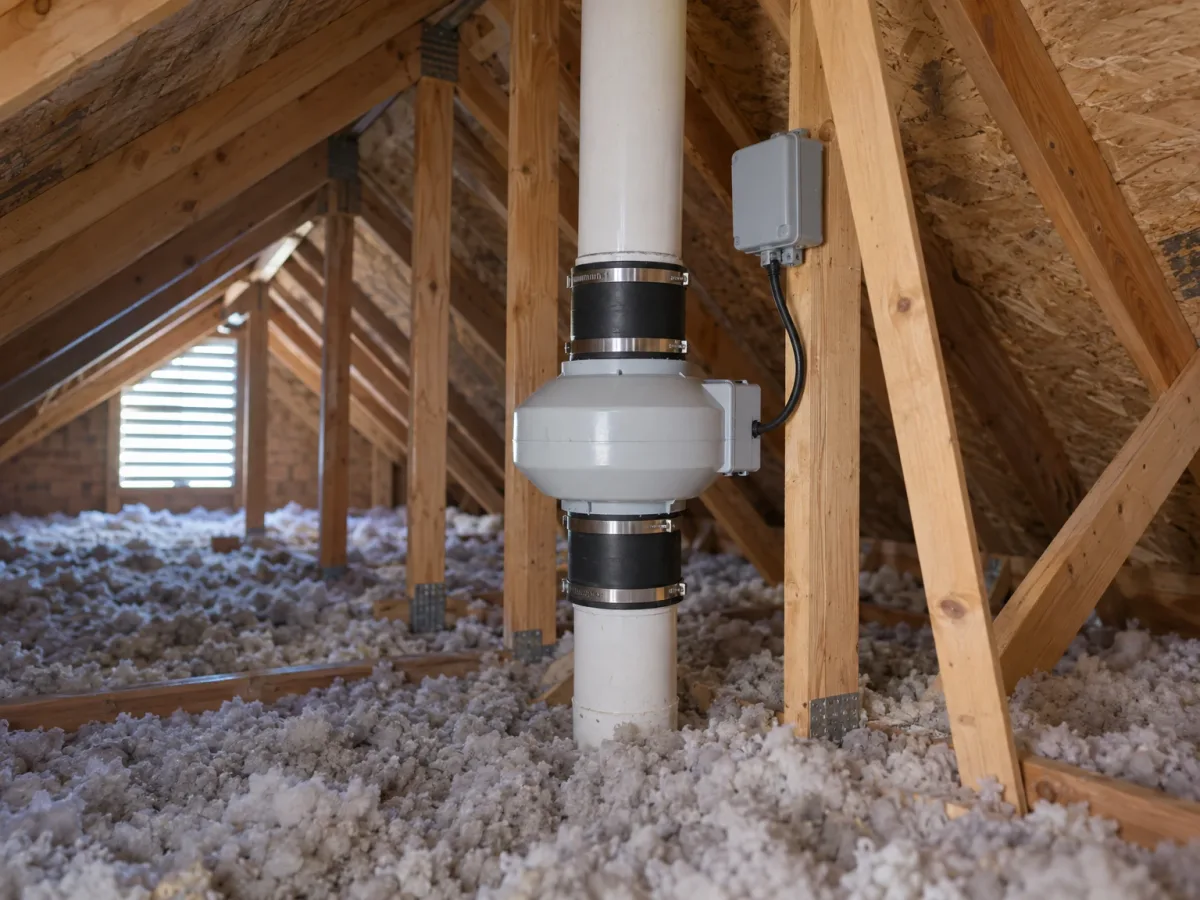
Does your home have a passive pipe?
Washington’s 1991 indoor air quality code asked builders in Spokane County for gravel under each slab and one sealed pipe from that gravel to the outdoors, labeled “radon vent,” with a 110-volt junction box waiting near the future fan spot.
That rule covered homes on a slab or over a basement. A crawl space of that era only needed an air barrier below the rooms, so a 1990s crawl-space home may have no pipe at all.
Idaho’s residential code leaves out the radon appendix, so a Kootenai County home has a pipe only if its builder chose to add one.
- Permit date in Spokane County on or after July 1, 1991
- A slab or basement floor, not only a crawl space
- A pipe marked “radon vent” somewhere you can see it
- A junction box near where that pipe reaches the attic
- A recent radon test at or above 4.0 pCi/L
The activation visit, step by step
- STEP 1
Start from a test result
We work from a radon test of 4.0 pCi/L or higher on the lowest lived-in floor. Without a recent number, a 48-hour monitor test from $195 comes first.
- STEP 2
Trace the pipe from slab to roof
We follow the pipe through each floor and the attic, looking for cracked joints, open fittings and missing labels. The price assumes your builder’s pipe is intact and reachable from the attic.
- STEP 3
Measure suction under the slab
We put a test vacuum on the pipe and read the pressure at small holes across the floor. The readings show whether the gravel is open and set the fan size.
- STEP 4
Mount the fan in the attic or outside
The fan sits on a vertical run in the attic or on an outside wall, never in or under the rooms you use, so a leak on its pressure side stays outdoors.8
- STEP 5
Wire it under a permit
We connect the fan to the builder’s junction box, add a disconnect within sight of the fan and have the circuit inspected.8
- STEP 6
Seal the openings we can reach
An open sump, floor cracks and gaps around pipes let the fan pull room air instead of soil gas, so we close them.
- STEP 7
Add a gauge, an alarm and labels
A manometer shows the suction we set, and an alarm off the fan’s circuit sounds if the fan stops. Labels tell the next owner what the system is.8
- STEP 8
Retest within 30 days
We test again no sooner than 24 hours after the fan starts and within 30 days, for two to seven days with the house closed up.1
What activation costs
Activation costs less than a new system because the hardest part, a sealed pipe from the gravel to the roof, is already inside your walls.
The first visit settles the rest: how easy the attic is to reach, whether the junction box is there and live, whether the pipe needs repair, and how far the suction spreads. You get the quote after that check.
The suction test sets the fan size, and the fan size sets the power bill. At Avista’s Washington rate, a 20-watt fan costs about $25 a year and a 90-watt fan about $115.
Fan, manometer and fan alarm, sealing, electrical permit, post-mitigation test and written guarantee below 4.0 pCi/L.
Why a passive pipe can still test high
For most of the years these pipes went in, no one had to measure the result. Under the 1991 code, each new house got a three-month detector at final inspection, and using it was up to the owner.
The 2021 International Residential Code added a testing section to its radon appendix: at 4 pCi/L or more, the code calls for the fan, then changes and retests until the result drops below 4. Washington adopted it effective March 15, 2024.
So a home built between 1991 and early 2024 may never have been tested with its pipe working alone. If you are buying one, test it during the purchase.2, 3, 4, 5
When the builder’s pipe needs more than a fan
The 1991 code asked for a T fitting in the gravel with at least five feet of perforated pipe off it. A pipe that simply ends in a hole, or a fitting packed with stone, has to be opened before the fan goes on.
The code also wants a pipe in each separate gravel area, or a 3-inch link for every 30 feet of footing between them. An addition on its own footing can sit outside the builder’s pipe and need a second suction point.2
Passive pipe or fan: EPA’s figures
Same pipe, same gravel. The ranges are EPA’s typical results, not a forecast for one house.
| Passive pipe | With a fan | |
|---|---|---|
| Typical radon reduction | 30 to 70 percent | 50 to 99 percent |
| EPA’s comment | “May be more effective in cold climates” | “Works best if air can move easily in material under slab” |
| Warning device | None, there is no fan to watch | Required, such as a liquid gauge or an alarm |
Source 1.
Permits and the rules behind your pipe
Washington treats a new fan as new electrical equipment, so the wiring needs a permit.
Electrical permit in Washington
A permit is required for “the installation, alteration, or maintenance of all electrical systems or equipment.” The exceptions cover like-in-kind replacements, not a new fan.6
Owners who wire it themselves
Outside cities that run their own program, an owner can apply to L&I for a property owner permit before starting work on their own home.7
Electrical permit for the fan circuit
City of Spokane
The City runs its own electrical permit program, so the permit comes from the City, not L&I. Its 2026 schedule charges $7.20 per circuit for wiring in an existing space.10, 11
Rest of Spokane County
Spokane Valley, Liberty Lake, Cheney, Airway Heights, Medical Lake, Deer Park and the unincorporated county go through Washington L&I. The residential fee is $78.80 for up to four added or altered circuits.10, 12
Post Falls
The City’s Building Division issues electrical permits. For an existing home the fee is $67 with one circuit included.13
The electrical permit is part of every install price. This is general information, not legal advice.
Questions
How much does it cost to activate a passive radon system?
Activation starts at $695, including the fan, manometer, fan alarm, sealing, electrical permit and post-mitigation test. That assumes the builder’s pipe is intact and reachable from the attic. If the first visit finds a break or a missing connection, we quote the repair before any work starts.
Do I need a permit to add the fan?
In Washington, yes. Wiring a new fan is new electrical work under WAC 296-46B-901. Owners may wire their own home with an L&I property owner permit taken out before the work starts; inside the City of Spokane the City issues it. When we do the work, the permit is in our price.
My house was built in 1995. Does it have a passive pipe?
In Spokane County, if it sits on a slab or over a basement, it should. The 1991 code required a pipe labeled “radon vent” and a 110-volt junction box for a future fan. A 1995 crawl-space home needed only an air barrier. Look for the label along the pipe or in the attic.
What if activation isn’t enough?
The follow-up test tells you. A reading of 4.0 pCi/L or higher means part of the soil under the house is beyond the reach of the builder’s pipe. We add a second suction point and apply the difference toward a full system.
Do passive radon systems work?
Sometimes well enough. EPA puts passive suction at 30 to 70 percent, so a home that starts high can stay above 4 pCi/L with the pipe alone. Only a test tells you where yours stands.
Sources (15)
- U.S. EPA, A Consumer’s Guide to Radon Reduction, EPA 402/K-10/005 (2025), pp. 10, 12, 13, 16
- K. A. Coleman, Washington State Department of Health, Washington’s Radon Construction Standards: The Building Code Process (AARST, 1993), pp. 1 and 5–7, with the 1991 Ventilation and Indoor Air Quality Code, sections 503.1 to 503.2.8
- International Code Council, 2021 International Residential Code, Appendix AF, Section AF104 Testing (as reproduced by SOS Radon)
- Environmental Law Institute, Radon Control in New Home Construction (updated July 2026)
- Washington Administrative Code 51-51-003, adoption of the 2021 International Residential Code with Appendix AF (effective March 15, 2024)
- Washington Administrative Code 296-46B-901, subsection 7, electrical work permits (2020)
- Washington L&I, F500-094-000 Property Owner Electrical Work Permit Application (07-2026), pp. 1–2
- ANSI/AARST SGM-SF-2023, Soil Gas Mitigation Standards for Existing Homes, sections 6.5, 7.3, 8.2, 8.3.1, 8.4, 9.2.1 and 10.2.1
- Idaho Code § 39-4109, Application of codes (2022)
- Washington L&I, City Electrical Permits & Inspections (retrieved October 2026)
- City of Spokane, Development Fee Schedule 2026
- Washington L&I, F500-133-000 Residential Electrical Fee Worksheet (fees effective July 1, 2026)
- City of Post Falls, Building Fee Schedule (revised October 1, 2026)
- Kootenai County, Residential Building Permit Submittal Guide
- IDAPA 24.39.10, Rules of the Idaho Electrical Board, section 500 (fees)