
Radon Mitigation in Mead, Colbert and Chattaroy, WA
North of Spokane the land climbs into granite highlands. Granite forms Mount Spokane and much of the rim around the Little Spokane River basin, and on the mountain's western flanks a uranium mineral fills cracks in it over roughly 100 square miles. In census tracts within the Mead, Colbert and Chattaroy ZIP codes, 39% to 57% of reported radon tests reached 4.0 pCi/L or more.
Or call (509) 278-2215
48-hour test from $195 · Systems from $1,295 · Post-mitigation test included
How it works in Mead, Colbert & Chattaroy
- STEP 1Test
A 48-hour continuous monitor in your lowest living level, under closed-house conditions. Report the same day it comes out.
- STEP 2Look and quote
We check the foundation, run a suction test and plan the pipe route for Mead, Colbert & Chattaroy winters. You get a fixed price in writing.
- STEP 3Install
Most systems take one day: suction point, sealing, fan, manometer and the electrical permit.
- STEP 4Re-test
A post-mitigation test at least 24 hours after the fan starts shows the new number. The guarantee is below 4.0 pCi/L.
Radon mitigation cost in Mead, Colbert & Chattaroy
Who powers the fan depends on the address. Federal utility data list both Avista and Inland Power & Light in unincorporated Spokane County, and your electric bill tells you which one serves you. Crawl-space membranes under manufactured homes and long pipe runs on big rural houses cost more than a single slab point; the pressure-field test and a look at the foundation set the price.
Starting prices include the electrical permit and the post-mitigation test. Bold: systems common in Mead, Colbert & Chattaroy homes. Estimate your system →
- Spokane County Minor Home Repair (run by SNAP) (radon not named, ask): Repairs of immediate health and safety hazards for lower-income owners outside Spokane city limits. 509-456-7627
- USDA Section 504 Home Repair (radon not named, ask): 1% loans up to $40,000, and grants up to $10,000 for owners 62 or older, for very low incomes in eligible rural areas. On USDA's map, Colbert and Chattaroy lie inside the eligible area, Mead does not. Check your address. 509-381-6722
for a typical 60-watt fan running around the clock, depending on which utility serves your address. Energy charge only, at 2026 residential rates.
A 20-watt fan costs about a third of that, a 90-watt fan half again as much.
Testing air and water north of Spokane
Run the air test in the lowest level you use, in the heating season, with the house closed up. The ZIP figures are rough here: the tracts used for the Colbert and Chattaroy ZIPs hold less than half of those ZIPs' homes, and the five tracts range from 39.2% to 56.8% of tests at 4.0 pCi/L or more. Your own result can land well outside that range in either direction.
Countywide, 13.1% of residents relied on their own water supply in 2010, mostly private wells; no figure exists for these ZIPs alone. Well owners should follow the health district's advice and have the water tested for uranium and arsenic. Near the old Colbert Landfill on Elk-Chattaroy Road, which took waste from 1968 to 1986, groundwater carries volatile organic compounds, and the cleanup there includes an alternate water supply for affected home wells.
The Washington State Department of Health sends free radon kits from a limited stock, with 8 to 10 weeks for delivery; the regional health district's program list has no radon entry. EPA advice is to fix at 4.0 pCi/L and above and, between 2 and 4, to consider it.
Permits and local rules in Mead, Colbert & Chattaroy
Mead, Colbert and Chattaroy are unincorporated, and Spokane County refers electrical permits for these areas to Washington L&I, which has a Spokane office at 901 N. Monroe Street. Since July 2026 a house permit runs $78.80 for as many as four circuits.16
Spokane County's design criteria use a 24-inch frost depth and a ground snow load of at least 39 psf, set site by site from county snow-load maps. The county notes snow loads as high as 150 psf in some areas, so the lot's own value guides an outdoor pipe run and its roof exit.17
Every new house in Spokane County has to follow Appendix F of the state residential code, which aims to keep radon out and leave the house ready for a fan. That includes Mead Works and the other new subdivisions here.9
Private well owners are advised by the Spokane Regional Health District to have their water tested for uranium and arsenic. That lab test is separate from a radon test of the indoor air.18
About 20–30 minutes from our shop.
Mead, Colbert & Chattaroy at a glance
Area figures describe the neighborhood, not your home. Only a test tells you your number. Sources are listed at the end of this page.
Granite, flood sand and clay north of Spokane
Mount Spokane and the south end of the Selkirk Mountains are two-mica granite, and the same rock is at the surface across much of the high ground ringing the Little Spokane basin. Many wells there are drilled straight into it. On the western flanks of the mountain, about 30 miles northeast of Spokane, the uranium mineral autunite coats fractures and shear zones over some 100 square miles, and the Daybreak mine took 13,400 tons of ore out of that ground by 1958.
U.S. Geological Survey geologists noted numerous uranium occurrences in the granitic hills north of Spokane and warned that buildings unknowingly placed on such concentrations are likely to have very high indoor radon. The same report put the expected average for homes in most alluvial valleys north and northwest of the city above 4 pCi/L. Along the Little Spokane, the Missoula floods left bars and terraces of sand and gravel hundreds of feet thick, and wind-blown dune sand covers the flood deposits around Mead and on western Peone Prairie.
Green Bluff is different again. It and its neighbors, Orchard Bluff, Pleasant Prairie and Orchard Prairie, are leftover basalt mesas sitting on Latah Formation clay and silt, with a cap of Palouse loess usually under 25 feet thick. One Green Bluff well passed through 595 feet of clay and silt. Granite slopes, sandy valley floors and clay-based mesas all fall inside the same few census tracts, so no area figure can sort them out. Only a test in the house shows its level.
of uranium ore, averaging 0.24% uranium oxide, mined on Mount Spokane's western flank through 19582
Farmhouses, manufactured homes and new subdivisions
The Census figures here describe the 99021, 99005 and 99003 ZIP areas, which reach well beyond the communities. In 2020 about three-quarters of the 99021 population lived in the Mead census-designated place, while 99005 and 99003 lay almost entirely outside any town or CDP. Across the three areas there are about 9,600 homes, about 9 in 10 of them owner-occupied, and 22.2% are mobile homes; in the 99003 area it is around two in five. Median build years fall in the mid-1980s for the 99021 and 99003 areas and around 1999 for 99005.
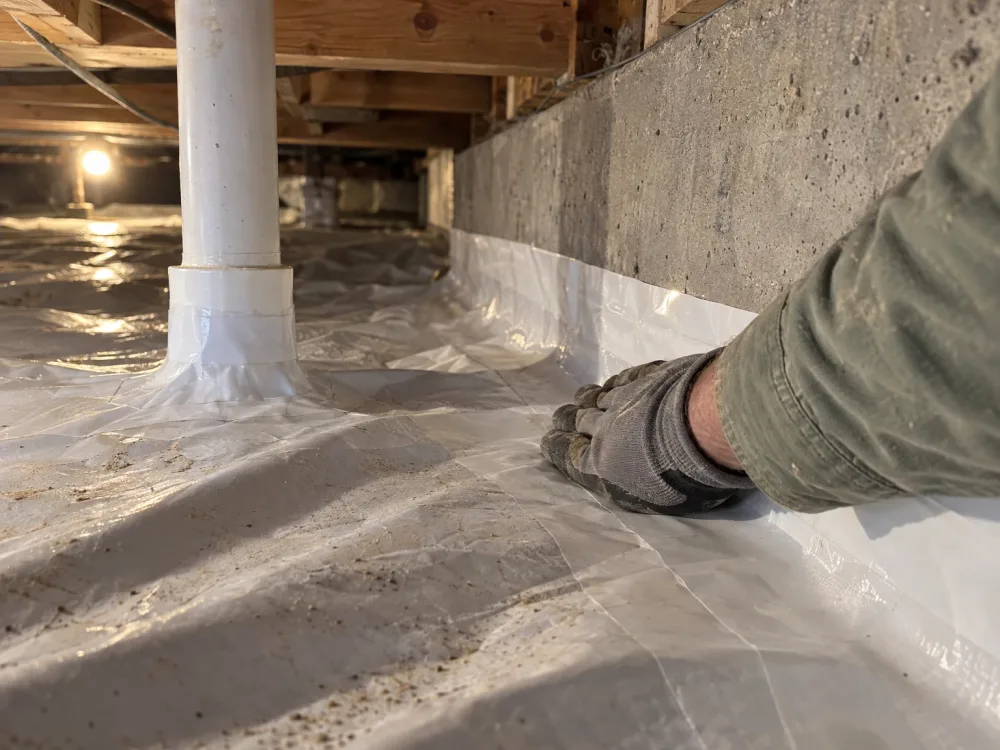
Those foundations call for different systems. A manufactured home or an addition over a crawl space gets a sealed membrane over the soil with a fan pulling from beneath it. Older farmhouses and 1980s homes with basements need a sub-slab suction point and a new pipe. Homes built since 2007 fall under the current version of the state's radon-resistant construction rules, which build in the means to add a fan later.
Settlement here is old, but the building boom is new. Chattaroy dates from the early 1880s, when Robert P. Cowgill opened a store and carried mail from Spokane Falls. At Mead, the World War II aluminum smelter that Kaiser bought in 1946 left 400 acres of buffer land, now being built out as Mead Works: about 1,400 homes over some 20 years, with the first houses started in fall 2024. In Colbert, the 500-unit Village at Midway is planned on North Hatch Road.
Share of homes by year built. Source 4.
Mead, Colbert & Chattaroy questions
Is radon higher near Mount Spokane?
The granite there carries uranium: USGS geologists recorded numerous uranium occurrences in the hills north of Spokane, and autunite fills fractures on the mountain's western flanks. No public data break radon down by foothill neighborhood, so testing is the only way to learn your home's level.
Do I need to test my well too?
Yes, if your water comes from a private well. The Spokane Regional Health District recommends testing for uranium and arsenic, which means a water sample sent to a lab, apart from the indoor radon test.
Does radon mitigation work on a manufactured home?
Yes. Over a crawl space or skirting, the usual method is a sealed membrane on the ground with a fan drawing air from underneath and venting it outside.
Who issues the permit in unincorporated Spokane County?
Washington L&I handles electrical permits for Mead, Colbert and Chattaroy, not the county. The $78.80 house fee covers up to four circuits and comes bundled in the starting price.
How much electricity does the fan use in a year?
A 60-watt fan uses about 526 kWh a year: roughly $47 on Inland Power & Light's rate or $76 on Avista's. Your address decides which of the two you pay.
We bought a new home at Mead Works. Should we test?
Yes. Washington requires radon-resistant construction in Spokane County, which readies a house for a fan, but it doesn't guarantee a reading under 4.0 pCi/L.
ZIP codes: 99021 · 99005 · 99003 · 99009
Sources for Mead, Colbert & Chattaroy (23)
- U.S. Geological Survey: Hydrogeology of the Little Spokane River Basin (SIR 2013-5124)
- Mineralogical Society of America: Autunite from Mt. Spokane, Washington (G. W. Leo, U.S. Geological Survey, American Mineralogist, 1960)
- Washington Tracking Network (WA Dept. of Health): Radon test results by census tract, all years
- U.S. Census Bureau: American Community Survey 2020–2024, ZIP code areas 99021, 99005 and 99003 (tables B25034, B25035, B25024, B25003)
- Journal of Business (Spokane): Greenstone to start work on first homes at Mead Works this fall (July 18, 2024)
- U.S. Geological Survey: Estimated use of water in the United States, county-level data for 2010
- U.S. Geological Survey: Geologic Radon Potential of EPA Region 10, Washington chapter (Open-File Report 93-292-J)
- U.S. Census Bureau: 2020 Census Demographic and Housing Characteristics File, Washington (block data by ZIP code area and place)
- Washington Administrative Code 51-51-60103: Appendix F requirements
- Washington Trust for Historic Preservation: Revisiting Washington, Chattaroy
- The Spokesman-Review: 400-acre Kaiser property in Mead slated for 1,400-residence mixed-use development (Feb. 4, 2021)
- Journal of Business (Spokane): The need for Mead: Over $1 billion in developments planned (Nov. 22, 2023)
- U.S. Energy Information Administration: Form EIA-861 annual electric power industry report, 2024 data
- Inland Power & Light: Residential rates (effective April 1, 2026)
- Avista Utilities: Calculating your residential electric bill, Washington (effective October 1, 2026)
- Washington L&I: Residential electrical fee worksheet, July 2026
- Spokane County Building & Planning: Building design criteria
- Spokane Regional Health District: Drinking water (private wells)
- Spokane County Building & Planning: Frequently asked questions
- Washington State Department of Ecology: Cleanup site Colbert Landfill (Site 3035)
- Washington State Department of Health: Radon
- Spokane Regional Health District: Programs and services
- U.S. EPA: What is EPA's action level for radon?
Find your number in Mead, Colbert & Chattaroy.
48-hour test from $195. Mitigation from $1,295 with the post-test included.