
Radon Testing in Spokane, 48-Hour Results
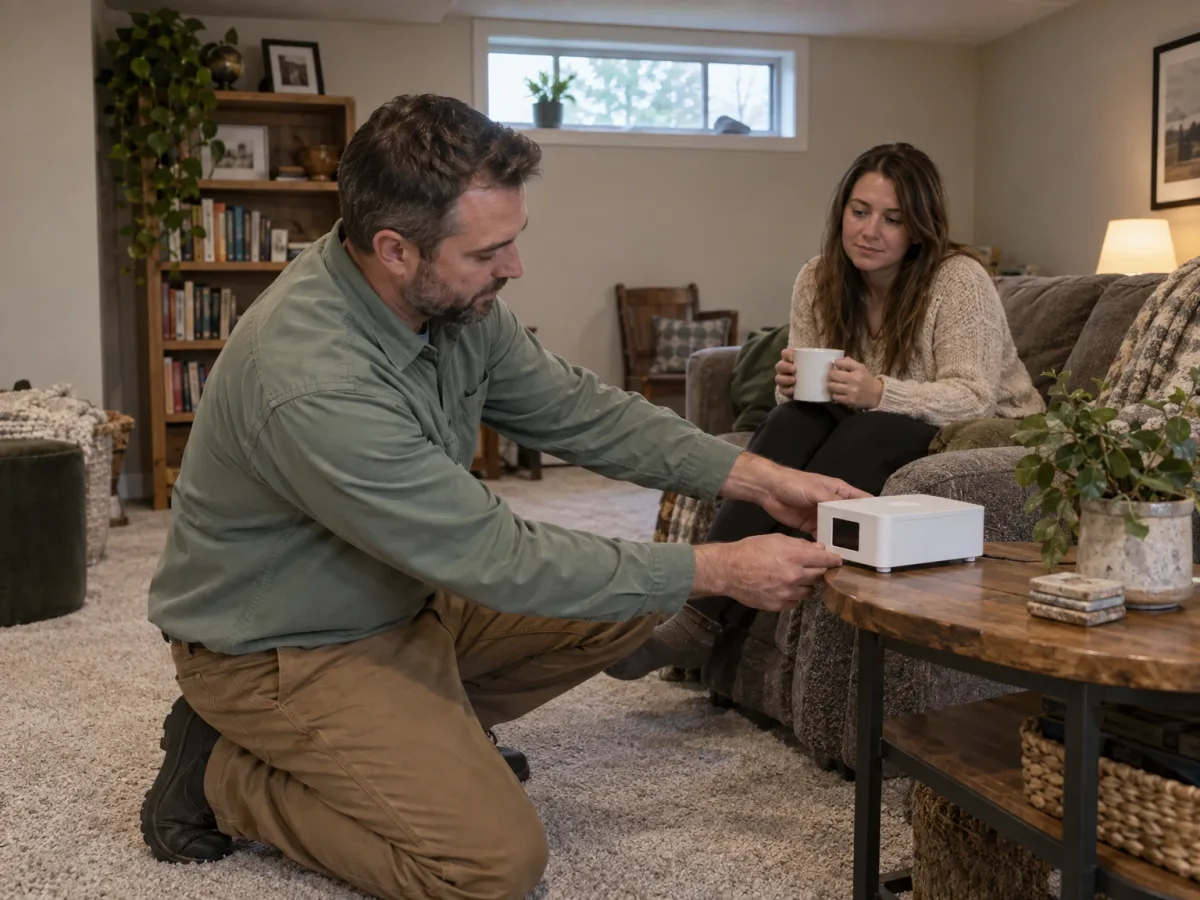
A technician places a continuous radon monitor in your lowest living level. It records radon every hour for at least 48 hours under closed-house conditions. You get the full report the day we pick it up.
Why test for radon in Spokane?
Radon gas rises from uranium in the rock and soil under the Inland Northwest and collects indoors, most of all in basements and crawl spaces. It has no color or smell, so nothing warns you. EPA estimates radon exposure causes about 21,000 lung cancer deaths a year in the U.S. and recommends testing every home below the third floor.
Every house tests differently
Cracks in the foundation, a sump pit, the gravel or basalt under the slab and how the house is heated all change how much radon gets in. A neighbor's low number says little about your home, and the health risks for your family depend on your own result.
In the Washington counties and Idaho towns on the right, 45 to 62 percent of reported tests came back at or above EPA's 4.0 pCi/L action level.
How often local tests come back high
Sources
Which test is right for you?
A DIY radon test kit is the cheapest start. Professional testing with a continuous monitor answers faster and records whether the house stayed closed.
DIY charcoal test kit
Placed by you for 2–7 days, then mailed to a lab. Free from the Department of Health, but allow 8–10 weeks for delivery.
Good for: a first screening48-hour continuous monitor
Placed by a technician. Hourly readings, tamper detection, temperature and humidity. Same-day report.
Good for: fast answers, real estate, post-mitigationLong-term test
An alpha-track detector left for 90 days to a year. It shows your average across seasons, which is the best basis for a decision near 4.0.
Good for: borderline resultsClosed-house conditions
An accurate test needs normal winter-like conditions for 12 hours before and throughout the test.
Why winter matters here
The Spokane Regional Clean Air Agency notes that radon levels can be highest in winter, with doors and windows closed. Warm air rising through the house draws soil gas in at the foundation, and Spokane's heating season is long.
A summer result below 4.0 is worth confirming in the heating season. We test year-round and note the season on every report.
Reading your result
Under 2.0 pCi/L
Re-test every two years or after renovations.
2.0 to 3.9 pCi/L
EPA suggests considering a fix. A long-term test gives you the seasonal average.
4.0 pCi/L or higher
EPA recommends fixing your home. A radon mitigation system usually goes in within a day; ours start at $1,295 with the follow-up test included. See how it works →
Free test kits
If you aren't in a hurry, a free kit is a reasonable first step.
Washington: the Department of Health mails a limited supply of free kits. Allow 8–10 weeks. The request form is available in English, Spanish, Russian and Vietnamese. Information: doh.radon@doh.wa.gov, 360-236-3246.
Idaho: the Department of Health and Welfare offers one free kit per address every two years when in stock; in October 2026 it was sold out. Other options →
Already have a result?
Send us the number from any kit or monitor. If it's 4.0 or higher we'll send a fixed mitigation price.
Testing questions
Where do you place the monitor?
In the lowest level you use or could use as living space, away from exterior walls, drafts, sumps and humidity sources, about 20 inches off the floor.
My neighbor tested low. Do I need to test?
Yes. Radon depends on the soil and foundation under each house. Homes next door to each other in Spokane can read very differently.
Can I test a newer home?
You should, new construction included. Spokane County has required passive radon measures since July 1991, but they're a minimum and newer homes still test high.
Should I test my well water too?
On a private well in Spokane, Stevens or Pend Oreille County, the Department of Health recommends a one-time uranium test from a certified lab. Water is rarely the main radon source: EPA puts household water at about 1 to 2 percent of the radon in indoor air, so the air test comes first.
Do you test after mitigation?
Always. A post-mitigation test is included with every system we install. We can also test systems installed by others.