
Basement Radon Mitigation in Spokane
A basement sits in soil on every side, so it is usually where radon gets in. We pull soil gas from under the slab, close the openings that old walls, sumps and drains leave, and plan the pipe around finished rooms.
Or call (509) 278-2215
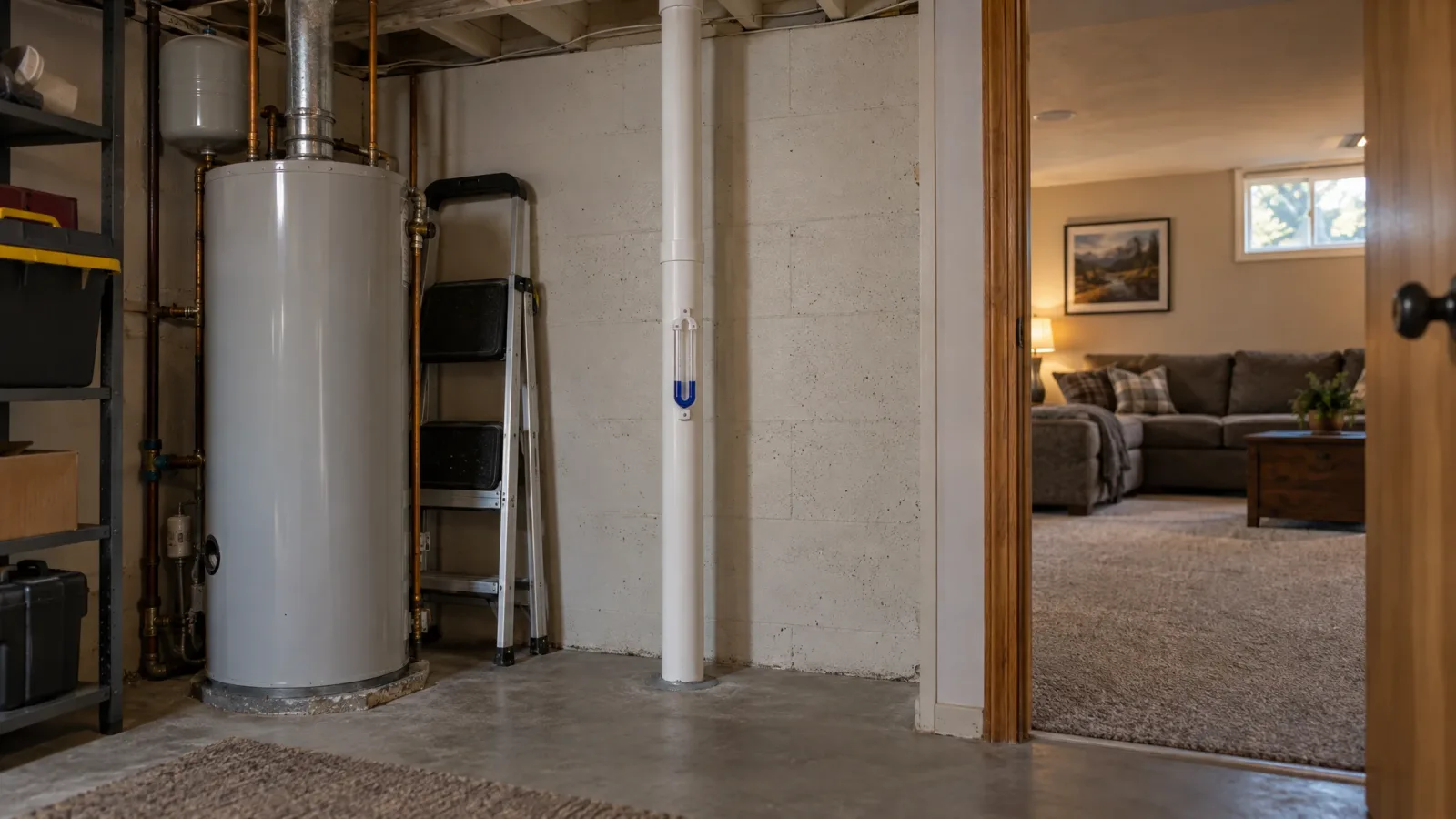
When a basement system fits
Your test result decides, not the age of the house. EPA’s action level is 4.0 pCi/L, with a fix worth considering from 2.0 up, measured on the lowest level you use.
Older basements add complications: hollow-block or fieldstone walls, a sump or drain tile, and rooms finished over the slab. For Kootenai County homes, the town pages below list Idaho results by ZIP code.
- Your test result and where it was taken
- Poured, hollow-block or fieldstone walls
- A sump, drain tile or floor drains to soil
- Finished rooms over the slab
- Dirt-floor rooms or an attached crawl space
- A pipe route to the attic or outside
How a basement install works
- STEP 1
Walk the basement with your result
We compare the reading with where it was taken and look at the walls, sump, drains and finished rooms.
- STEP 2
Measure how far suction reaches
With vacuum on one test hole, we read pressure at other holes across the slab. That shows whether one suction point is enough.4
- STEP 3
Core the suction point
We core the slab in an unfinished spot, clear a pit in the fill below and seal the gap around the pipe for good.4
- STEP 4
Close the openings that leak air
We seal the floor-to-wall joint and the cracks and pipe gaps we can reach. The sump gets a sealed lid, and drains to soil get a trap.4
- STEP 5
Run the pipe and place the fan
The pipe goes through a closet or chase to the attic, or out the rim joist and up the outside wall. The fan sits in the attic or outdoors.3
- STEP 6
Test once the fan is running
The follow-up test starts 24 hours to 30 days after the fan is switched on and runs two to seven days with windows and doors closed.3
What sets a basement price
The table shows the starting price and the add-ons. Three things move a basement quote most: how much slab one suction point must cover, whether finished rooms limit the drilling spot, and whether the pipe runs inside or outside.
Open block tops, a sump without a sealed lid, untrapped drains or tight soil that needs a second suction point add time. We find them before we quote.
Suction and sealing, fan, manometer, electrical permit, post-mitigation test, written guarantee below 4.0 pCi/L, 5-year fan and workmanship warranty.
Old block and stone walls
Hollow block and fieldstone walls leak in different ways.
Hollow block walls are rows of open cells. Where the top row has no solid cap, soil gas can rise through the cells into the basement. We close the open tops, cracks and pipe gaps first. EPA lists block-wall suction for these walls, and the standard requires the cells to be closed wherever it is used. We add it only when the pressure readings call for it.
Fieldstone walls have no cells. Gas moves through the mortar joints, and suction under the slab may not reach the soil behind them, so we take readings near the wall before we settle the design.3, 4, 5
Finished basements
Finished rooms limit where we can drill and run the pipe, not how suction works under the slab. We look for a utility room, storage closet or the space under the stairs, and the pressure readings confirm the suction reaches under the finished rooms.
Flooring and framing also hide most cracks. In a 1986 study of crack sealing in Spokane River Valley homes, Lawrence Berkeley Laboratory named finished basements as the place where most defects could not be reached.
Planning to finish the basement later? Tell us first, so the pipe stays in an unfinished corner. After a remodel, EPA advises a retest in the lowest lived-in area.6, 3
Sumps and floor drains
A sump pit opens into the gravel and drain tile under the floor, one of the largest gaps in a basement. The standard calls for a rigid lid on any sump that connects to soil, fastened so it comes off for pump work and sealed with a gasket or silicone. The pit keeps draining as before.
We use the sump as the main suction point only when other spots cannot reach far enough, since the standard’s guidance warns of harder pump access and more noise.
Floor drains that run to soil can let gas up and pull basement air into the system. EPA’s technical guidance says such a drain must be trapped. A waterless trap with a floating ball keeps its seal even when dry.4, 5
Living with the system
The standard recommends checking the system monitor each quarter and testing at least every two years, and again after a sump or drain tile is added or altered or a never-tested lower room is put to use. Fans may last five years or more. At Avista’s Washington rate, a 20 to 150 watt fan costs about $25 to $191 a year.4, 3
Basement methods compared
Sub-slab suction is EPA’s most common method. The others suit drain tile, a sump or hollow block walls.
| Typical reduction | Where it fits | |
|---|---|---|
| Sub-slab suction | 50 to 99% | Fill under the slab that lets air move |
| Drain-tile suction | 50 to 99% | Drain tile around part or all of the footing |
| Sump-hole suction | 50 to 99% | A sump that air reaches easily from under the slab |
| Block-wall suction | 50 to 99% | Hollow block walls only, with major openings sealed |
| Sealing alone | Not shown to work consistently | Only together with suction |
Source 3.
Rules for a basement system
ANSI/AARST SGM-SF-2023 is the U.S. standard for radon systems in existing homes. Three of its rules shape a basement job.
Fan location
Not in heated or lived-in space and not directly beneath it, so never in the basement itself.4
Exhaust
Outdoors, at least 10 feet above the ground and at least 1 foot above a pitched roof where the pipe passes through.4
Labels
A label on each floor the pipe runs through, plus labels on the fan and the sump lid.4
Electrical permit for the fan circuit
City of Spokane
The City runs its own electrical permit program, so the permit comes from the City, not L&I. Its 2026 schedule charges $7.20 per circuit for wiring in an existing space.8, 9
Rest of Spokane County
Spokane Valley, Liberty Lake, Cheney, Airway Heights, Medical Lake, Deer Park and the unincorporated county go through Washington L&I. The residential fee is $78.80 for up to four added or altered circuits.8, 10
Post Falls
The City’s Building Division issues electrical permits. For an existing home the fee is $67 with one circuit included.11
The electrical permit is part of every install price. This is general information, not legal advice.
Questions
How much does basement radon mitigation cost in Spokane?
A basement system starts at $1,295. A finished basement adds $250, an inside pipe route instead of an outside one adds $400, and larger footprints add $200 per 1,000 square feet. The walk-through and the pressure test settle the rest.
Will the system damage my finished basement?
Usually not. We drill in an unfinished spot such as a utility room or closet. Pipe that crosses a finished ceiling can be boxed in, with a label left visible.
Should my sump pit be covered for radon?
Yes, if it connects to the soil or drain tile under your floor. An open sump lets soil gas in and lets the fan pull basement air. A rigid, sealed lid that comes off for pump service fixes both, and the sump keeps draining.
Does sealing basement cracks lower radon on its own?
Not reliably. EPA does not recommend sealing alone because “by itself, sealing has not been shown to lower radon levels significantly or consistently,” and a settling house opens new gaps. Sealing still matters as part of a system, because it keeps the fan pulling from the soil.
Part of my basement is a dirt floor. Is that a problem?
It is a large opening to soil, but it can be handled. We cover the soil with plastic sheeting sealed at the walls and draw from under it with the same fan. If you want to use the room, a new slab over gravel is the other option.
Sources (13)
- Washington State Department of Health, Washington Tracking Network: Radon Test Results by County, 1990–2020
- U.S. Census Bureau, ACS 5-Year Estimates 2020–2024, Table B25034 Year Structure Built, Spokane County (2025)
- U.S. EPA, A Consumer’s Guide to Radon Reduction, EPA 402/K-10/005 (2025), pp. 9–16
- ANSI/AARST, SGM-SF-2023 Soil Gas Mitigation Standards for Existing Homes (2023), §§ 5.3.5, 6.1, 6.4, 6.5.2, 7.1–7.8, 8.2, 8.4, 10.2.1
- U.S. EPA, Radon Reduction Techniques for Existing Detached Houses, EPA/625/R-93/011 (1993), pp. 92, 97, 181–183, 194
- Lawrence Berkeley Laboratory, Radon and Remedial Action in Spokane River Valley Residences, LBL-21399 (1986), p. 11
- U.S. EPA, A Citizen’s Guide to Radon, EPA 402/K-12/002 (2025)
- Washington L&I, City Electrical Permits & Inspections (retrieved October 2026)
- City of Spokane, Development Fee Schedule 2026
- Washington L&I, F500-133-000 Residential Electrical Fee Worksheet (fees effective July 1, 2026)
- City of Post Falls, Building Fee Schedule (revised October 1, 2026)
- Kootenai County, Residential Building Permit Submittal Guide
- IDAPA 24.39.10, Rules of the Idaho Electrical Board, section 500 (fees)