
Radon in Spokane, WA: What the Neighborhood Data Show
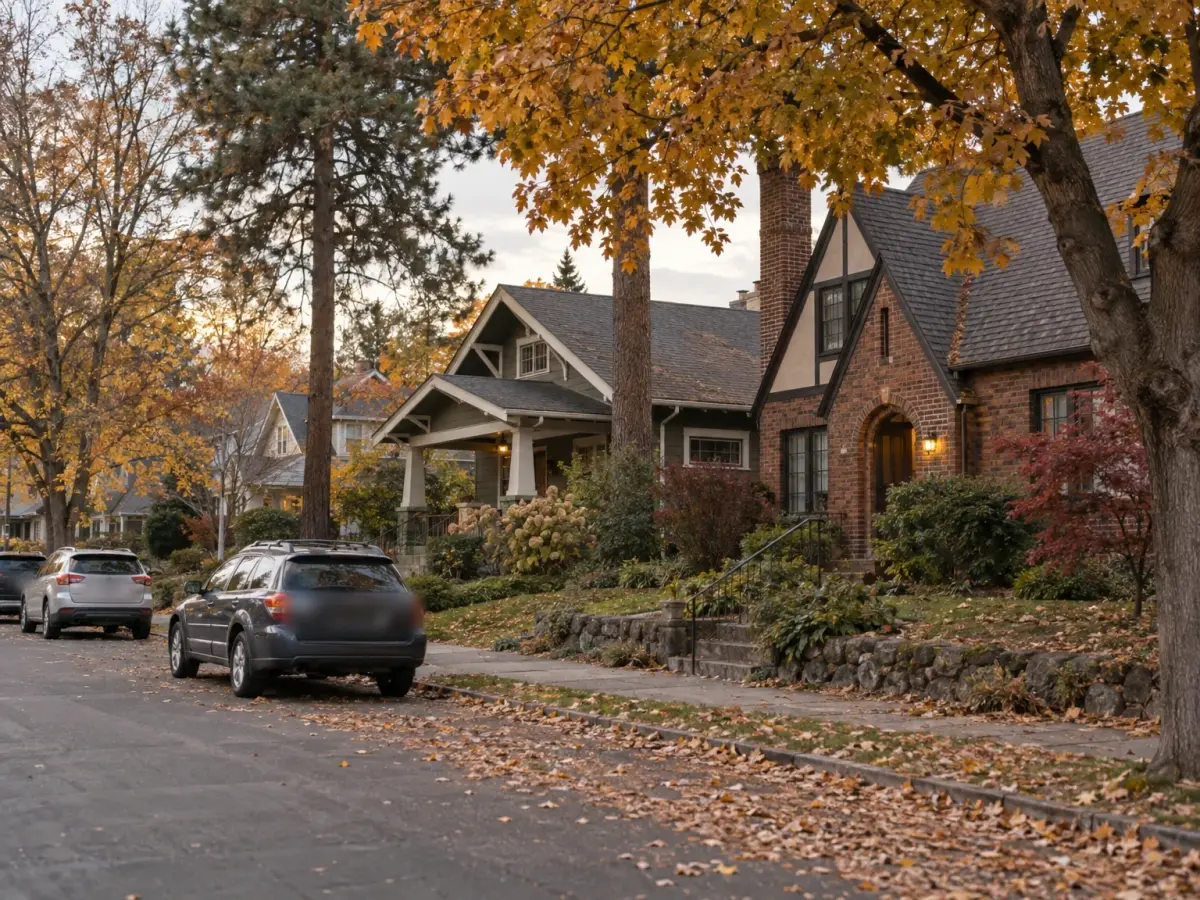
Spokane's radon picture changes with the ground under each neighborhood. North of the river, much of the city stands on deep Ice Age flood gravel; downtown, the river falls over basalt, and Five Mile Prairie is a mesa of granite and lava. State test records follow suit: by census tract, the share of high results runs from about one in six to two in three.
Or call (509) 278-2215
48-hour test from $195 · Systems from $1,295 · Post-mitigation test included
How it works in Spokane
- STEP 1Test
A 48-hour continuous monitor in your lowest living level, under closed-house conditions. Report the same day it comes out.
- STEP 2Look and quote
We check the foundation, run a suction test and plan the pipe route for Spokane winters. You get a fixed price in writing.
- STEP 3Install
Most systems take one day: suction point, sealing, fan, manometer and the electrical permit.
- STEP 4Re-test
A post-mitigation test at least 24 hours after the fan starts shows the new number. The guarantee is below 4.0 pCi/L.
Radon mitigation cost in Spokane
Inside city limits the fan runs on Avista power, and the city, not the state, permits the circuit. North of the river, gravel usually carries suction well under a slab. On Five Mile Prairie's clay or near basalt, a pressure-field test before the quote shows whether one suction point is enough. In older houses, the bigger task is often finding a clean route for the pipe.
Starting prices include the electrical permit and the post-mitigation test. Bold: systems common in Spokane homes. Estimate your system →
- City of Spokane Minor Home Repair (run by SNAP) (radon not named, ask): Free or low-cost health and safety repairs for owners inside city limits with income under 80% of the area median. 509-456-7627
for a typical 60-watt fan running around the clock. Energy charge only, at 2026 residential rates.
A 20-watt fan costs about a third of that, a 90-watt fan half again as much.
Testing a home in Spokane
Run the test in the lowest room someone uses, with doors and windows shut, ideally while the furnace is running in fall or winter. Results swing widely between Spokane tracts, so no map or neighbor's reading can stand in for one taken in your own house.
Free state kits exist, but the Washington State Department of Health has only a limited supply and asks for 8 to 10 weeks. The Spokane Regional Health District has no radon kit program, and the Spokane Regional Clean Air Agency points people to hardware-store kits. For a sale or a deadline, a 48-hour continuous monitor gives a report the day it ends.
Federal guidance is simple: at 4.0 pCi/L or more, fix the house; from 2 to 4, the EPA says to consider it.
Permits and local rules in Spokane
Spokane runs its own electrical permit and inspection program, so the fan circuit goes through the city rather than Washington L&I. The 2026 fee schedule lists $7.20 per circuit for wiring in existing space; the base fee isn't published.17
City design criteria call for 24 inches of frost depth and a 39 psf ground snow load, with a 30 psf minimum roof snow load. Outside pipe runs and roof penetrations are planned for both.18
Spokane County is on the state code's list of high radon potential counties, so new houses must include the radon control methods of Appendix F.14
Washington's seller disclosure form asks about environmental concerns and names radon gas among them. A dated test result lets you answer with a measurement.19
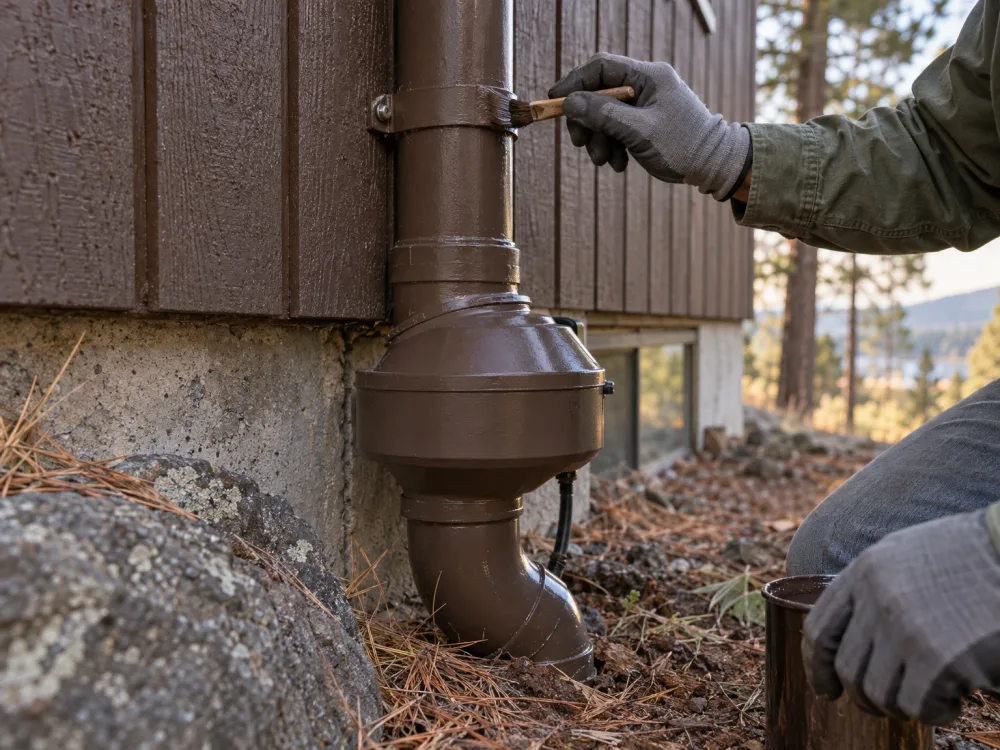
Same-week testing across the city. Most installs are scheduled within 7–10 days of your quote.
Spokane at a glance
Area figures describe the neighborhood, not your home. Only a test tells you your number. Sources are listed at the end of this page.
Gravel, basalt and lake clay under one city
North of the river, much of Spokane is built on Ice Age flood gravel. It fills the deep old channels of the Spokane and Little Spokane rivers several hundred feet thick: a poorly sorted mix of boulders, cobbles, pebbles and sand, from granitic and metamorphic rock like that found locally and in Idaho. In 1993 the U.S. Geological Survey described the city and its eastern suburbs as built on highly permeable glacial outwash, ground that lets soil gas travel freely.
Other parts of the city sit on different ground. Downtown, the river drops over basalt ledges at Spokane Falls. In the northwest corner, Five Mile Prairie is a 3,400-acre mesa of granite and lava that stands 400 feet high, with basalt cliffs on almost every side. Well logs there pass through more than 100 feet of Latah Formation, a soft, finely layered siltstone and claystone laid down in Miocene lakes. Gravel, rock and clay each let gas through in their own way.
State test records show the result. In census tracts within ZIP codes 99201, 99202, 99204, 99205, 99208 and 99218, the share of reported tests at or above 4.0 pCi/L ranges from 16.1% to 66.9%. ZIP 99205 alone has one tract at 16.1% and another at 62.3%. These are tests people chose to run, not a random survey, but the lesson holds: a Spokane address tells you little about a Spokane basement.
of homes above 4 pCi/L in some townships near Spokane, in data the USGS cited in 19935
How Spokane's houses were built, and when
Spokane went from about 1,000 residents in 1881 to more than 100,000 by 1910, and much of that boom is still standing. After the 1889 fire, downtown was rebuilt in brick and stone. Browne's Addition, west of downtown, got the city's first streetcar in 1888 and filled with mansions for mining and timber barons. Peaceful Valley, along the river just west of downtown, is mostly simple wood-frame workers' houses on narrow lots, and West Central's Nettleton's Addition is the largest historic district in Washington.
North of the river, building followed the streetcars. North Hill's Craftsman bungalows, Tudors and two-story farmhouses went up in the early 1900s along the Howard and Madison Street lines. Shadle Park High School opened in 1957 to serve the 1940s and 1950s tracts in Audubon/Downriver. After the city annexed land north of Francis Avenue in the 1950s, houses spread north, reaching North Indian Trail in the 1970s. The median Spokane home was built in 1961.
Only 8.3% of the city's homes date from 2010 or later, and on Five Mile Prairie old farmsteads now stand beside new subdivisions. Homes built to Washington's radon-resistant construction rules may already have a passive vent pipe. The older majority were built without one and usually need a full sub-slab system: a suction point through the floor, a sealed pipe and a fan outside the living space.
Share of homes by year built. Source 3.
Spokane questions
Which Spokane neighborhoods test highest for radon?
The state publishes radon data by census tract, not by neighborhood. In the six ZIP codes this page covers, 12 of 29 tracts have half or more of reported tests at 4.0 pCi/L or above, and they turn up in five of the six ZIPs. Your own house can land anywhere on that scale, so test it.
Is Spokane worse for radon than the rest of Washington?
In 2020, 44% of Spokane County's reported tests reached 4.0 pCi/L or more, twice the statewide 22%. In the 1991–92 state and EPA survey, Spokane County had the highest average of any Washington county listed, 9.9 pCi/L.
Does the city or the state permit a radon fan in Spokane?
The City of Spokane, through its own inspection program, not Washington L&I. The permit is part of our quoted price.
We live on Five Mile Prairie. Is the ground different up there?
Yes. The prairie is a mesa of granite and lava over thick lake clay, while the plain below is flood gravel. Homes on and below the mesa can test very differently, and only a test of your house shows its level.
Can a radon system go on a historic house in Browne's Addition or West Central?
Yes. The fix is the same as anywhere: suction under the floor, a sealed pipe and a fan outside the living space. What takes more care is the route, so the pipe stays off the front of the house and out of finished rooms.
How much power does a radon fan use in Spokane?
A 60-watt fan running nonstop uses about 526 kWh a year, close to $76 at Avista's Washington rates effective October 2026. A small 20-watt fan comes to roughly $25 a year.
ZIP codes: 99201 · 99202 · 99204 · 99205 · 99208 · 99218
Sources for Spokane (23)
- Washington Tracking Network (WA Dept. of Health): Radon test results by census tract, all years
- Washington Tracking Network (WA Dept. of Health): Radon test results by county, 1990–2020
- U.S. Census Bureau: American Community Survey 2020–2024, Spokane city (tables B25034, B25035, B25001)
- Washington DNR, Geology and Earth Resources: Geologic Map of the Spokane Northwest 7.5-minute Quadrangle (Open File Report 2004-3)
- U.S. Geological Survey: Geologic Radon Potential of EPA Region 10, Washington assessment (Open-File Report 93-292-J)
- City of Spokane: Five Mile Prairie Neighborhood Profile
- HistoryLink.org: Spokane – Thumbnail History (Essay 7462)
- HistoryLink.org: Spokane's first streetcar runs to Browne's Addition, April 15, 1888 (Essay 8087)
- HistoryLink.org: Peaceful Valley, Spokane (Essay 20402)
- City of Spokane: West Central Neighborhood Profile
- City of Spokane: North Hill Neighborhood Profile
- City of Spokane: Audubon/Downriver Neighborhood Profile
- City of Spokane: North Indian Trail Neighborhood Profile
- Washington Administrative Code 51-51-60101: Appendix F, radon control methods
- Avista Utilities: Calculating your residential electric bill, Washington (effective October 1, 2026)
- Washington L&I: City electrical permits and inspections
- City of Spokane: Development Fee Schedule 2026
- City of Spokane: Spokane Municipal Code 17F.040.105, design criteria
- Revised Code of Washington 64.06.020: Seller disclosure statement
- Washington State Department of Health: Radon
- Spokane Regional Health District: Programs and services
- Spokane Regional Clean Air Agency: It's National Radon Action Month (January 2026)
- U.S. EPA: What is EPA's action level for radon?
Find your number in Spokane.
48-hour test from $195. Mitigation from $1,295 with the post-test included.