
Radon Mitigation on Spokane's South Hill
The South Hill is basalt country, and plenty of owners assume rock means low radon. The state's test records say otherwise. In census tracts within the 99203 and 99223 ZIP areas, between about a quarter and a half of reported tests reached the EPA action level. That is lower than much of Spokane, but far from rare.
Or call (509) 278-2215
48-hour test from $195 · Systems from $1,295 · Post-mitigation test included
How it works in South Hill
- STEP 1Test
A 48-hour continuous monitor in your lowest living level, under closed-house conditions. Report the same day it comes out.
- STEP 2Look and quote
We check the foundation, run a suction test and plan the pipe route for South Hill winters. You get a fixed price in writing.
- STEP 3Install
Most systems take one day: suction point, sealing, fan, manometer and the electrical permit.
- STEP 4Re-test
A post-mitigation test at least 24 hours after the fan starts shows the new number. The guarantee is below 4.0 pCi/L.
Radon mitigation cost in South Hill
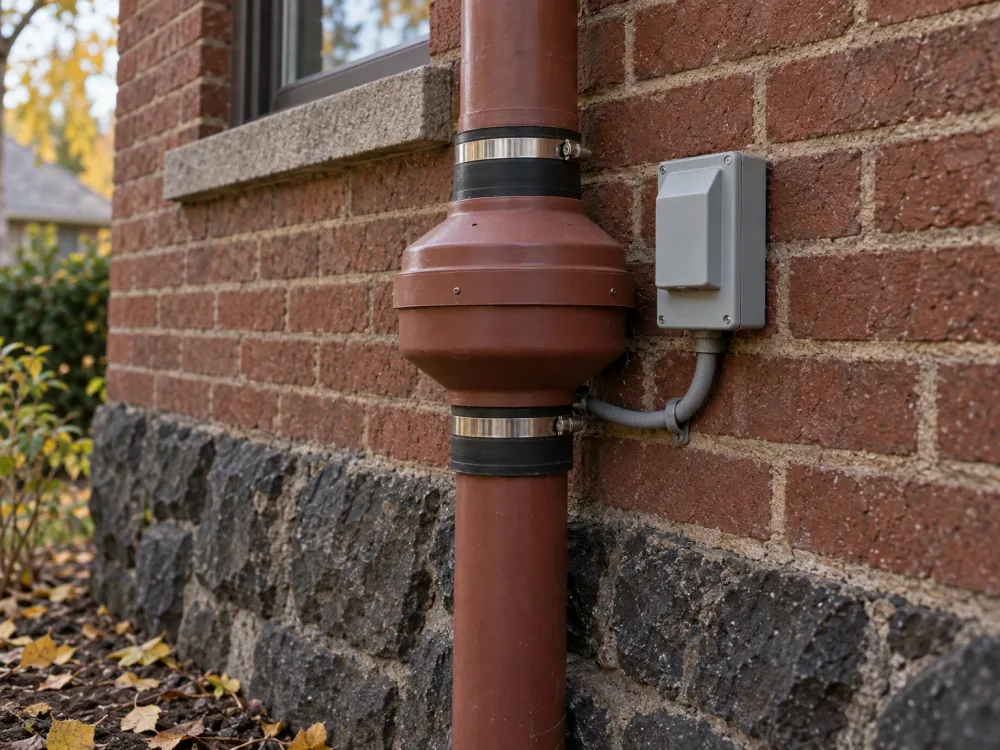
Basalt close under a slab can keep suction from spreading, so a pressure-field test comes before the quote, and some South Hill houses need a second suction point. On finished older homes, routing is usually the harder question: an interior chase or a tidy run up the back wall. The fan runs on Avista power inside the city.
Starting prices include the electrical permit and the post-mitigation test. Bold: systems common in South Hill homes. Estimate your system →
- City of Spokane Minor Home Repair (run by SNAP) (radon not named, ask): Free or low-cost health and safety repairs for owners inside city limits with income under 80% of the area median. 509-456-7627
for a typical 60-watt fan running around the clock. Energy charge only, at 2026 residential rates.
A 20-watt fan costs about a third of that, a 90-watt fan half again as much.
Testing on the South Hill
Test where you live lowest: a finished basement room if you use one, the main floor if you don't. Keep windows and doors shut, and if you can, test while the heat is on.
Free kits are available from the Washington State Department of Health in limited numbers, with delivery in 8 to 10 weeks. If you are buying or selling, a 48-hour continuous monitor gives an hour-by-hour record and a report the same day.
The EPA's line is 4.0 pCi/L; between 2 and 4, it suggests considering a fix. The tract figures on this page describe thousands of houses at once, not yours.
Permits and local rules in South Hill
Inside city limits, the City of Spokane issues the permit for the fan circuit, at $7.20 per circuit for existing space in its 2026 schedule; it doesn't publish a base fee. Parts of ZIP 99223 are unincorporated, and there Washington L&I issues it: $78.80 for up to four circuits (July 2026).12
The city's design values are a 24-inch frost depth, a 39 psf ground snow load and at least 30 psf of roof snow load. Exterior pipe runs and roof flashings are planned around them.16
Because the state residential code lists Spokane County as a high radon potential county, new South Hill homes are built with Appendix F radon controls.17
Form 17, the Washington seller disclosure, asks whether radon gas or other environmental concerns affect the property. Sellers answer from what they know; a test turns that into a number.18
About 10 minutes from our shop. Weekend test placement available.
South Hill at a glance
Area figures describe the neighborhood, not your home. Only a test tells you your number. Sources are listed at the end of this page.
What's under the South Hill
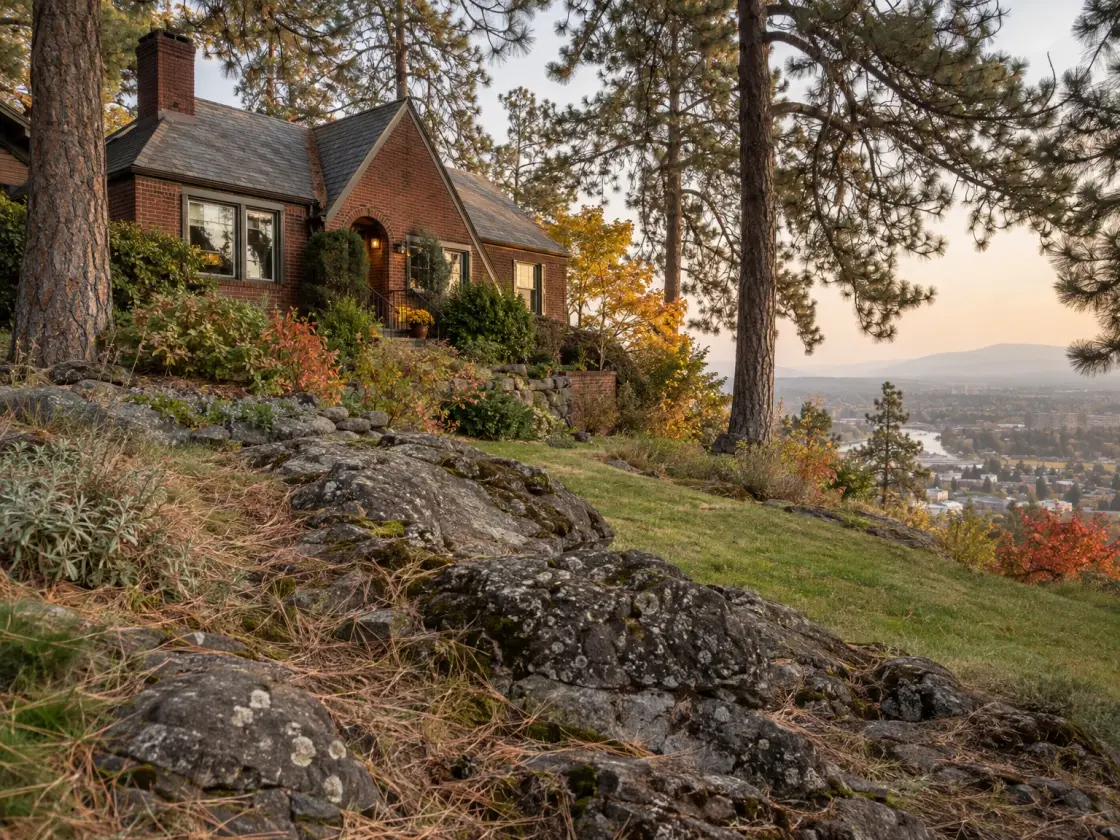
HistoryLink describes Spokane's first fine neighborhoods as rising on the basalt-strewn heights above downtown, and the rock is still in plain view. In Rockwood it breaks the surface all over the neighborhood; it set where streets and lots went a century ago, and native rock walls are everywhere. In Lincoln Heights, outcrops and ridgelines bend streets into curves and dead ends.
Under the southern part of the hill and the High Drive bluff, the state's geologic map shows something more layered than solid rock. Dense Columbia River basalt flows alternate with soft, poorly cemented Latah Formation siltstone and claystone, some of it saturated with water. Over that lies a cap of wind-blown silt, mostly montmorillonite and illite clay, usually just 1 to 2 feet thick here and thicker to the south, where the Ice Age floods scoured less.
Even the hill isn't uniform. In the 1880s a clay deposit turned up where Cannon Hill Park is now; it was dug for bricks, and the pit became the park's wading pool. State test records for census tracts within ZIP codes 99203 and 99223 range from 25.7% to 52.7% at or above 4.0 pCi/L, and 9 of the 11 tracts fall below the county-wide 47.0%. Below average still means about one test in four or more came back high.
typical thickness of the clay-rich wind-blown silt over basalt and Latah beds on the southern hill7
South Hill homes, street by street
The north half of the hill filled in first. Manito/Cannon Hill grew along streetcar lines that ran from 1888 to 1936; Manito Park was dedicated in 1904, and most homes there are early 20th-century houses on short grid blocks with alleys, many built without garages. Rockwood's 350 homes went up over half a century along curving, Olmsted-style streets, and the district joined the National Register in 1997. In ZIP 99203, 48.9% of homes predate 1950.
Farther south the hill is younger. Comstock was built mostly after World War II, once the Manito Boulevard extension opened in 1947. Lincoln Heights was platted in 1909, but many lots sat empty for decades, so Craftsman houses share its streets with mid-century ranches and newer split-levels. In Southgate, at the north end of Moran Prairie, multi-level homes are common. New building today is mostly infill south and east of Comstock Park and along High Drive.
That spread decides the system. Pre-war basements were built decades before any radon rule and have no pipe, so they need sub-slab suction and careful sealing. Split-levels and multi-level homes may need suction under more than one slab. Newer houses in the 99223 area may already have a builder's passive pipe.
Share of homes by year built. Source 3.
South Hill questions
Our house is on basalt. Can it still have high radon?
Yes. In census tracts within ZIPs 99203 and 99223, between 25.7% and 52.7% of reported tests reached 4.0 pCi/L or more. Rock under a house does not rule radon out; only a test of the house does.
Can a radon system get suction when the slab sits close to rock?
Usually. A pressure-field test before the quote shows how far suction reaches under the floor; where rock limits it, a second suction point is the usual answer.
Who permits a radon fan on the South Hill?
The City of Spokane for addresses inside city limits, Washington L&I for the unincorporated parts of ZIP 99223. Either way, the permit is in our price.
We have a split-level. Is that one system or two?
Often one fan with two suction points, one under each slab. Whether one point can reach both levels depends on what lies under the floors, which the pressure-field test shows.
Does the thin soil on the hill change how we should test?
No. Test the same way as anywhere else: lowest lived-in level, house closed. Soil and rock affect how a system is built, not whether you need a test.
What does the fan add to an Avista bill?
About $76 a year for a 60-watt fan running all the time, at Avista's October 2026 Washington energy rate. A 90-watt fan runs about $115.
ZIP codes: 99203 · 99223 · 99204
Sources for South Hill (20)
- Washington Tracking Network (WA Dept. of Health): Radon test results by census tract, all years
- Washington Tracking Network (WA Dept. of Health): Radon test results by county, 1990–2020
- U.S. Census Bureau: American Community Survey 2020–2024, ZIP code areas 99203 and 99223 (tables B25034, B25035)
- HistoryLink.org: Spokane – Thumbnail History (Essay 7462)
- City of Spokane: Rockwood Neighborhood Profile
- City of Spokane: Lincoln Heights Neighborhood Profile
- Washington DNR, Geology and Earth Resources: Geologic Map of the Spokane Southwest 7.5-minute Quadrangle (Open File Report 2004-4)
- City of Spokane: Manito/Cannon Hill Neighborhood Profile
- City of Spokane: Comstock Neighborhood Profile
- City of Spokane: Southgate Neighborhood Profile
- Avista Utilities: Calculating your residential electric bill, Washington (effective October 1, 2026)
- City of Spokane: Development Fee Schedule 2026
- U.S. Census Bureau: 2020 Census Demographic and Housing Characteristics File, Washington (population by ZIP area, county and place)
- Washington L&I: Residential electrical fee worksheet, July 2026
- Spokane County Building & Planning: Frequently asked questions
- City of Spokane: Spokane Municipal Code 17F.040.105, design criteria
- Washington Administrative Code 51-51-60101: Appendix F, radon control methods
- Revised Code of Washington 64.06.020: Seller disclosure statement
- Washington State Department of Health: Radon
- U.S. EPA: What is EPA's action level for radon?
Find your number in South Hill.
48-hour test from $195. Mitigation from $1,295 with the post-test included.