
Radon Fan Replacement and Repair in Spokane
A radon fan runs every hour of the year, so sooner or later it wears out. We find out why your system stopped pulling, replace the fan when it is the cause and leave the gauge marked so you can check it yourself.
Or call (509) 278-2215
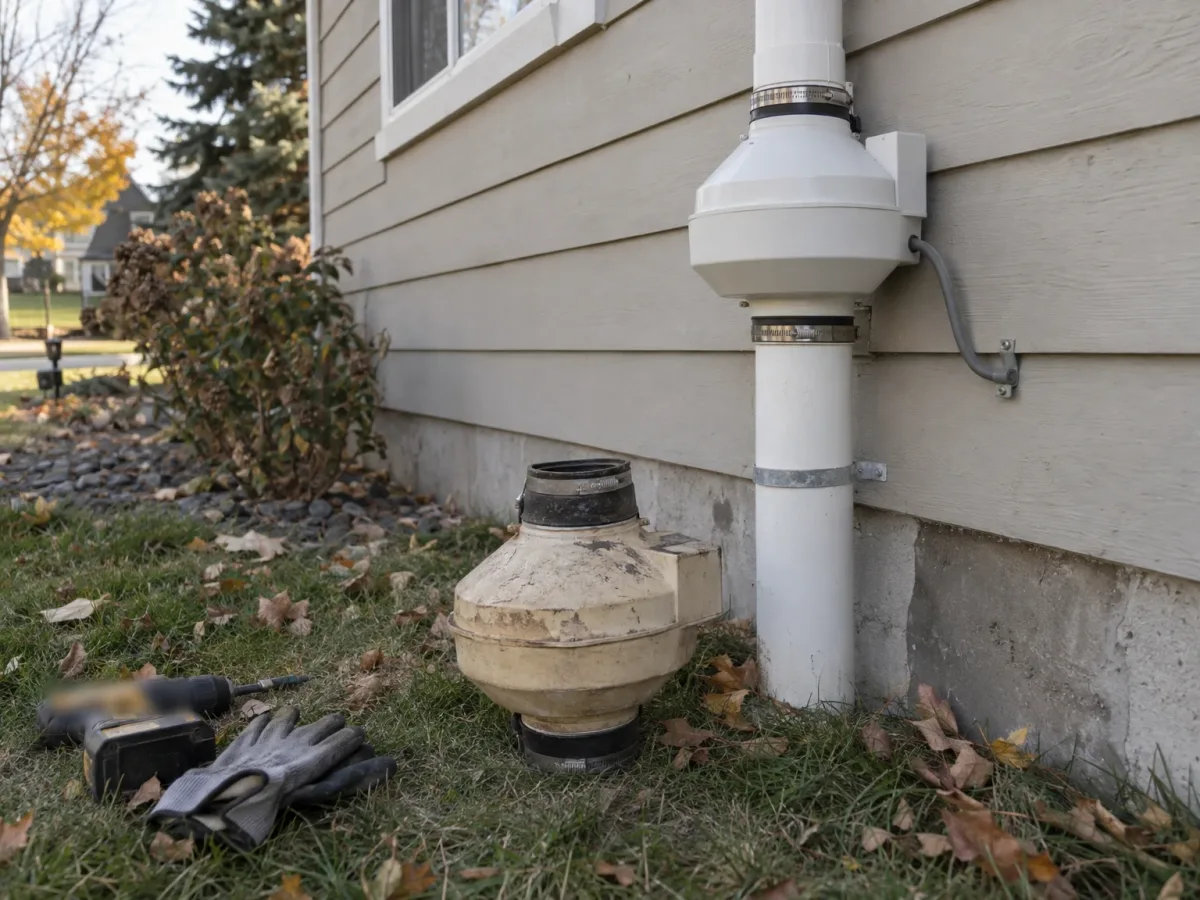
Signs your fan needs attention
The fan is the only moving part of an active system, and EPA’s guide says fans may last five years or more.
A failing fan gives no smell or draft to warn you, so SGM-SF-2023 requires a gauge and an alarm on every fan system and recommends checking the gauge every quarter.
Spokane winters add one more cause. When condensation freezes inside an attic or outdoor pipe, the Minnesota Department of Health notes that radon levels in the building will increase.
- The gauge liquid sits level or reads zero
- The reading has moved well away from the mark made at startup
- The alarm sounds or its warning light is on
- The fan grinds, squeals or rattles, or has gone silent
- Ice builds up at the exhaust during a cold snap
- A retest comes back at or above 4.0 pCi/L
The service visit, step by step
We work on any brand and any installer’s system, and we start with the cause.
- STEP 1
Read the gauge and the label
We compare today’s reading with the mark from startup and note the install date and installer from the system label.
- STEP 2
Rule out the simple causes
We check the gauge tubing, the switch and the breaker, then look for ice or a blocked exhaust. A kinked tube can look just like a dead fan.4
- STEP 3
Test the fan itself
With power confirmed, we listen for bearing noise and check airflow. A fan that has power and still does not pull is replaced.
- STEP 4
Fit the right replacement
The new fan is sized to the suction your system needs and mounted on a vertical run with the outlet up, so condensation drains back through it.6
- STEP 5
Check exhaust and fan location
On a system put in before 2023, we check the exhaust and fan location against SGM-SF-2023 and price any fix separately.3
- STEP 6
Seal and protect the pipe
We check couplings, joints and the suction point for leaks, and suggest insulation where an attic or outdoor run has frozen, as EPA advises in long cold spells.9
- STEP 7
Re-mark the gauge and log the work
We mark the new reading on the gauge and log what we found and replaced, as SGM-SF-2023 asks for every repair.2
- STEP 8
Retest the house
We recommend a short-term radon test once the new fan has run for at least 24 hours.1
What the price covers
The starting price is for a like-for-like fan swap on a system that otherwise works. It covers the new fan, labor and a check of the whole system.
If the visit finds a cracked pipe, a missing alarm, or an exhaust or fan location below the standard, we quote that work separately and you decide.
Bigger is not better. At Avista’s Washington rate a 20-watt fan costs about $25 a year and a 150-watt fan about $191, so the new fan is matched to your system.
New fan with manufacturer warranty, labor, and a check of the whole system.
Reading the gauge
Most systems carry a U-tube manometer, a tube of colored liquid tied into the radon pipe. While the fan pulls, one side stands higher. Level liquid means no suction.
Zero is not the target. SGM-SF-2023 requires the gauge to be marked with the reading taken when the system met its goals. Compare against that mark, and call if the reading has moved far from it in either direction.
Before you call, the Minnesota Department of Health suggests two quick checks: the tubing is still attached and not kinked, and the fan has power at its switch and breaker.2, 4
Repair or replace
When the fan has power and still does not pull, or its bearings grind, it is replaced. Under SGM-SF-2023, swapping a worn fan for an equivalent one counts as an incidental repair, not a new installation.
Often the fan is fine and something around it is not. Each of these is a repair, not a new fan:2, 4
- A tripped breaker or a disconnect switch turned off
- Gauge tubing that has slipped off or kinked
- Ice or debris blocking the exhaust
- A cracked pipe joint or loose coupling that leaks air
Older systems and the 2023 standard
ANSI/AARST SGM-SF-2023 does not reach back to every older system, with two exceptions: any part that is altered, and any exhaust or fan location that breaks its rules. AARST’s 2024 bulletin applies this to fan replacements: a non-compliant exhaust or fan location now has to be fixed.
The fix can mean extending the exhaust or moving the fan. The rules it is checked against:2, 3
- Fan not in heated or occupied space and not directly beneath it, such as a basement, crawl space or garage under a bonus room
- Fan in an attic, on an outside wall or in a garage with no living space above
- Exhaust aimed upward, at least 10 feet above the ground
- Exhaust at least 10 feet to the side of windows and doors that open, and 4 feet from openings below it
- A roof exhaust at least 1 foot above a pitched roof where the pipe passes through
Permits for a fan swap
Washington’s list of electrical work that needs no permit covers a like-in-kind motor, not a whole fan unit. Who issues the permit depends on your address, and we check it before the visit. This is general information, not legal advice.
Washington L&I
WAC 296-46B-901 exempts the like-in-kind swap of a motor of ten horsepower or less, but not the replacement of an equipment unit that contains one.10
City of Spokane
Inside city limits, electrical permits come from the City’s own program rather than from L&I.11
Post Falls
The City’s Building Division handles electrical permits and inspections for homes inside city limits.12
Rest of Kootenai County
Outside city limits, permits come from the Idaho Division of Occupational and Professional Licenses, whose rules say a permit must be bought before work begins.13
Questions
How much does it cost to replace a radon fan?
A fan replacement starts at $450: the new fan, labor and a check of the whole system. A cracked pipe, a missing alarm or an exhaust below SGM-SF-2023 is priced separately, and nothing extra happens without your approval.
How long do radon fans last?
EPA’s Consumer’s Guide says fans may last five years or more, and that manufacturer warranties tend not to exceed five years. Age alone is no reason to replace a fan that holds its startup reading.
Can I replace a radon fan myself?
Some owners do. RadonAway’s instructions say its RP fans are “intended for use by trained, professional, certified/licensed radon mitigators,” that “all wiring must be performed by a qualified and licensed electrician,” and that its five-year warranty needs a professional installer. Permit rules apply either way.
Why is my radon fan making noise?
A low, steady hum is normal, says fan maker Festa, and rushing comes from airflow in the pipe. A hum carried through the house usually means the fan or pipe touches the structure, which RadonAway says to avoid. Grinding or squealing points to worn bearings.
What happens if the radon fan stops?
The system stops venting soil gas and the gauge falls to level. Fan maker Fantech says radon may return to pre-mitigation levels within a few hours, and EPA says the fan should never be turned off. Check the breaker and switch, then call for service.
Sources (14)
- U.S. EPA, A Consumer’s Guide to Radon Reduction, EPA 402/K-10/005 (2025), p. 13
- ANSI/AARST, SGM-SF-2023 Soil Gas Mitigation Standards for Existing Homes (2023), §2.2, §6.4, §6.5, §8.2, §10.2.1
- AARST Consortium on National Standards, Technical Bulletin SGM-SF 2023 and SGM-MFLB 2023 (February 2024), p. 2
- Minnesota Department of Health, Radon Mitigation System Important Safety Information (2023), pp. 3 and 7
- Fantech, Radon Mitigation FAQ, “Does a radon fan have to run continuously?” (retrieved October 2026)
- RadonAway, RP / RPc Series Installation Instructions, IN020 Rev X (2018), pp. 3 to 8
- Festa Radon Technologies, Do Radon Mitigation Fan Systems Make Noise? (2025)
- Festa Radon Technologies, Signs It’s Time To Replace Your Radon Fan (2023)
- U.S. EPA, Building Radon Out, EPA/402-K-01-002 (2001), p. 63
- Washington State Legislature, WAC 296-46B-901 Electrical work permits, subsection (7)(b) (effective 2020)
- Washington L&I, City Electrical Permits & Inspections (retrieved October 2026)
- City of Post Falls, Building Fee Schedule (revised October 1, 2026)
- IDAPA 24.39.10, Rules of the Idaho Electrical Board (2023), section 500
- Avista Utilities, Calculating your monthly residential electric bill, Washington, effective October 1, 2026