
Radon Mitigation in Hillyard and Northeast Spokane
Hillyard sits over the Hillyard Trough, a deep, sediment-filled arm of the Spokane aquifer under northeast Spokane. Its fill is finer than the Spokane Valley's boulder gravel, yet the state's test records here are among the highest in Spokane: in 8 of 10 census tracts within ZIPs 99207 and 99217, half or more of tests reached 4.0 pCi/L.
Or call (509) 278-2215
48-hour test from $195 · Systems from $1,295 · Post-mitigation test included
How it works in Hillyard
- STEP 1Test
A 48-hour continuous monitor in your lowest living level, under closed-house conditions. Report the same day it comes out.
- STEP 2Look and quote
We check the foundation, run a suction test and plan the pipe route for Hillyard winters. You get a fixed price in writing.
- STEP 3Install
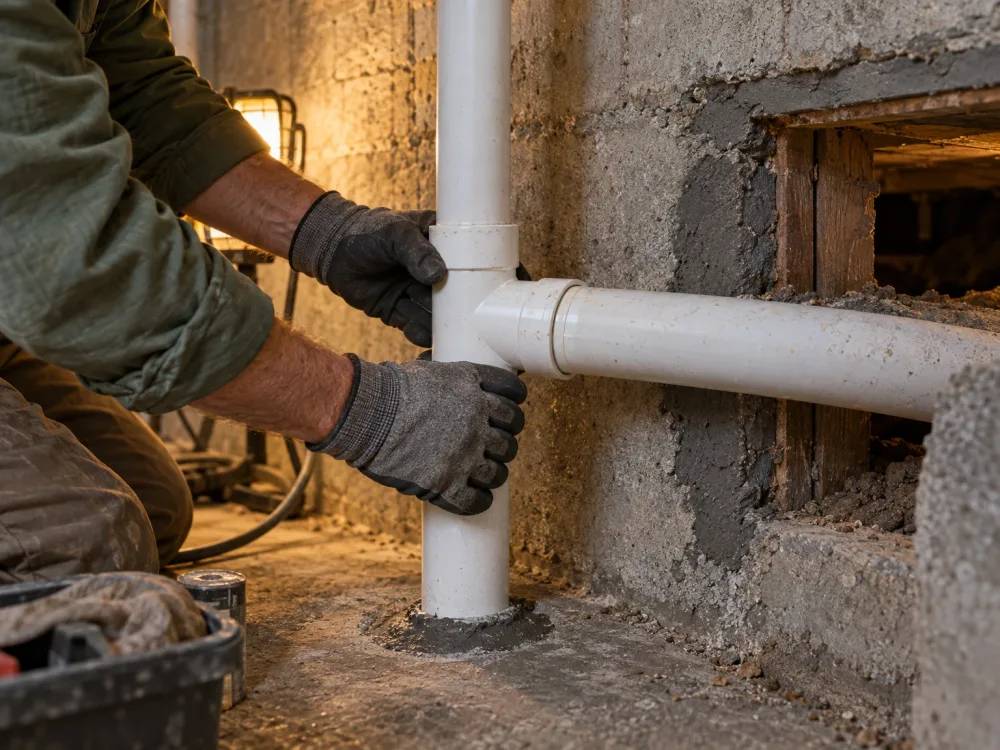
Most systems take one day: suction point, sealing, fan, manometer and the electrical permit.
- STEP 4Re-test
A post-mitigation test at least 24 hours after the fan starts shows the new number. The guarantee is below 4.0 pCi/L.
Radon mitigation cost in Hillyard
Sand and gravel in the trough usually let suction reach well under a slab, though silty layers can shorten its reach, so the quote follows a pressure-field test. A house with both a basement and a crawl space can usually run them on one fan. Inside the city, Avista supplies the power that runs it.
Starting prices include the electrical permit and the post-mitigation test. Bold: systems common in Hillyard homes. Estimate your system →
- City of Spokane Minor Home Repair (run by SNAP) (radon not named, ask): Free or low-cost health and safety repairs for owners inside city limits with income under 80% of the area median. 509-456-7627
for a typical 60-watt fan running around the clock. Energy charge only, at 2026 residential rates.
A 20-watt fan costs about a third of that, a 90-watt fan half again as much.
How to test a Hillyard home
Use the lowest level someone spends time in, keep the house closed, and test in the heating season when you can. In a house with a basement, that is usually the basement.
Washington's health department mails free kits while its limited supply lasts, usually in 8 to 10 weeks. National Radon Program Services at Kansas State University sells short-term kits for $20. For a home sale, a 48-hour continuous monitor gives a dated, hour-by-hour record.
With 8 of 10 local tracts at half or more, a high result would not surprise anyone, but a low one wouldn't either. EPA puts the action level at 4.0 pCi/L and asks owners between 2 and 4 to think about a fix too.
Permits and local rules in Hillyard
In the city, Spokane's own Development Services Center permits the fan circuit; its 2026 schedule charges $7.20 per circuit in existing space and doesn't list a base fee. Unincorporated parts of 99217 go through Washington L&I at $78.80 for up to four circuits (July 2026).13
Spokane designs for frost 24 inches deep and a 39 psf ground snow load; roofs must carry at least 30 psf. Those figures shape how the vent pipe is supported and flashed.16
The state residential code lists Spokane County as a high radon potential county. New homes here must follow Appendix F, and unvented crawl spaces are not permitted.17
Washington's Form 17 asks sellers whether radon gas or other environmental hazards are a concern on the property. A recent test gives the answer a date and a number.18
About 15 minutes from our shop.
Hillyard at a glance
Area figures describe the neighborhood, not your home. Only a test tells you your number. Sources are listed at the end of this page.
Finer ground in the Hillyard Trough, high numbers anyway
The Hillyard Trough is an arm of the Spokane Valley–Rathdrum Prairie aquifer. Before the Ice Age floods, the Spokane River probably flowed through it, along the east side of the Five Mile Prairie plateau and then west down today's Little Spokane valley. The trough now holds the aquifer's greatest known thickness: a 780-foot well never reached the bottom of the glacial and flood deposits, and bedrock is estimated at about 860 feet down.
What fills it is finer than the Valley's. USGS describes sand with some gravel, silt and boulders, where the center of the Spokane Valley has coarse, bouldery gravel. Silt and clay beds, probably laid down in glacial Lake Columbia, run through the trough's gravels; the main one averages 215 feet thick. USGS reads that as a slack-water setting, where fine material settled instead of being swept away by the floods.
You might expect finer ground to hold radon back. The test data don't show it. In census tracts within ZIP codes 99207 and 99217, between 34% and 68.3% of reported tests came in at or above 4.0 pCi/L, and 8 of the 10 reach half or more. Across the city's other ZIP codes, fewer than a third of tracts do. Back in 1993, the U.S. Geological Survey flagged the permeable glacial outwash under Spokane and its eastern suburbs as radon ground.
estimated depth to bedrock in the Hillyard Trough, the aquifer's thickest known point6
Rail-town houses and the northeast suburbs
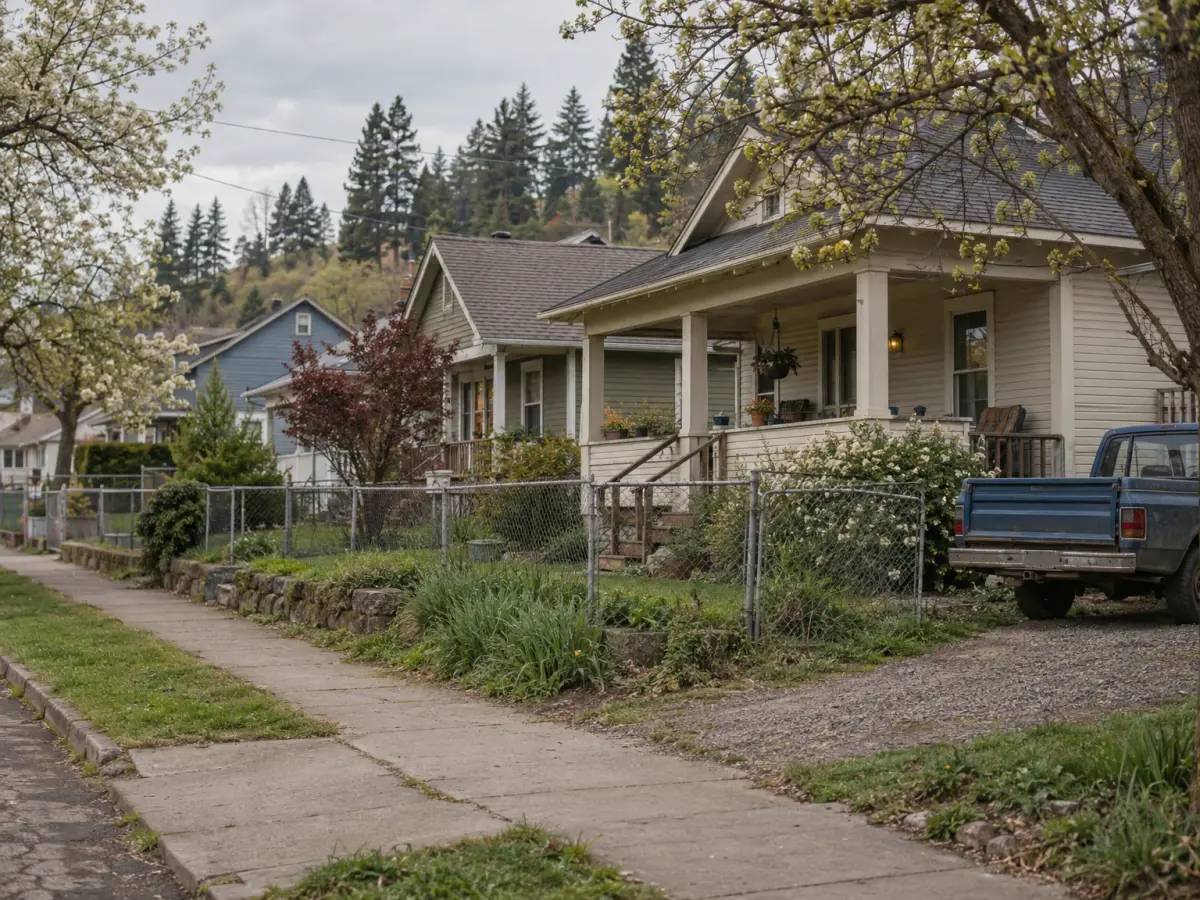
Hillyard began as a railroad town. Its townsite was platted in 1892 for 5,000 people beside the Great Northern yard, whose shops became the railroad's largest west of St. Paul and from 1927 built heavy freight locomotives. Italian and Japanese neighborhoods grew up around them. Hillyard stayed independent until a 1924 vote of 808 to 681 joined it to Spokane, with about 4,500 residents on just under a square mile.
Next door, Bemiss had seven residential additions laid out by 1890, with Craftsman houses for big families and smaller bungalows for rail workers. Nevada/Lidgerwood shows how the northeast grew in bands: mostly 1910 to 1950 south of Wellesley Avenue, the 1950s and '60s between Wellesley and Francis, and after the early 1960s north of Francis. In ZIP 99207, which lies entirely inside the city, 48.9% of homes predate 1950.
ZIP 99217, farther north and east, is newer, with a median home from the mid-1980s, and 42.4% of its 2020 residents lived in unincorporated Spokane County. Railroad-era houses have no radon pipe and usually need a full sub-slab system. Where a basement sits next to a crawl-space addition, each part needs its own suction.
Share of homes by year built. Source 3.
Hillyard questions
How common is high radon around Hillyard?
Common in the state's records: in 8 of 10 census tracts within ZIPs 99207 and 99217, half or more of reported tests were at 4.0 pCi/L or above. Those figures describe the area, and only a test describes your house.
Doesn't Hillyard's sandier, siltier ground help?
Not as far as the data show. The trough holds more sand, silt and clay than the Spokane Valley, but local test results are still high.
Our house has a basement and a crawl space. One system or two?
Usually one fan with two suction legs: one under the basement slab and one under a sealed membrane in the crawl space. The pressure-field test confirms the layout.
Which office permits the fan circuit in Hillyard?
Inside the city it is Spokane's own Development Services Center; in the county part of 99217 it is Washington L&I. It's included in the price either way.
What will the fan cost to run in Hillyard?
Roughly $76 a year for a 60-watt fan on Avista's Washington residential rate, or about $25 for a 20-watt fan.
ZIP codes: 99207 · 99217
Sources for Hillyard (21)
- Washington Tracking Network (WA Dept. of Health): Radon test results by census tract, all years
- Washington Tracking Network (WA Dept. of Health): Radon test results by county, 1990–2020
- U.S. Census Bureau: American Community Survey 2020–2024, ZIP code areas 99207 and 99217 (tables B25034, B25035)
- City of Spokane: Hillyard Neighborhood Profile
- U.S. Geological Survey: Hydrogeologic Framework and Ground-Water Budget of the Spokane Valley–Rathdrum Prairie Aquifer (SIR 2007-5041)
- U.S. Geological Survey: Spokane Valley–Rathdrum Prairie Aquifer compilation, hydrogeology (SIR 2005-5227)
- U.S. Geological Survey: Geologic Radon Potential of EPA Region 10, Washington assessment (Open-File Report 93-292-J)
- HistoryLink.org: Spokane Neighborhoods: Hillyard – Thumbnail History (Essay 8406)
- City of Spokane: Bemiss Neighborhood Profile
- City of Spokane: Nevada/Lidgerwood Neighborhood Profile
- U.S. Census Bureau: 2020 Census Demographic and Housing Characteristics File, Washington (population by ZIP area, county and place)
- Avista Utilities: Calculating your residential electric bill, Washington (effective October 1, 2026)
- City of Spokane: Development Fee Schedule 2026
- Washington L&I: Residential electrical fee worksheet, July 2026
- Spokane County Building & Planning: Frequently asked questions
- City of Spokane: Spokane Municipal Code 17F.040.105, design criteria
- Washington Administrative Code 51-51-60101: Appendix F, radon control methods
- Revised Code of Washington 64.06.020: Seller disclosure statement
- Washington State Department of Health: Radon
- National Radon Program Services (Kansas State University): Radon test kits
- U.S. EPA: What is EPA's action level for radon?
Find your number in Hillyard.
48-hour test from $195. Mitigation from $1,295 with the post-test included.