Radon Mitigation in Spokane County, WA
Spokane County stands out in Washington's radon data. In the 1991–92 state survey its homes had the highest average of any Washington county in the survey, and of 18,518 tests reported from 1990 through 2020, 47.0% reached the EPA action level. The county also takes in farm towns, lake communities and well-water country, and their numbers differ widely.
Or call (509) 278-2215
48-hour test from $195 · Systems from $1,295 · Post-mitigation test included
How it works in Spokane County
- STEP 1Test
A 48-hour continuous monitor in your lowest living level, under closed-house conditions. Report the same day it comes out.
- STEP 2Look and quote
We check the foundation, run a suction test and plan the pipe route for Spokane County winters. You get a fixed price in writing.
- STEP 3Install
Most systems take one day: suction point, sealing, fan, manometer and the electrical permit.
- STEP 4Re-test
A post-mitigation test at least 24 hours after the fan starts shows the new number. The guarantee is below 4.0 pCi/L.
Radon mitigation cost in Spokane County
Five electric utilities serve nearly all homes in Spokane County: Avista, Inland Power & Light, Modern Electric Water, Vera Water & Power and the City of Cheney. Which one powers your fan depends on the address, and the most expensive rate is more than twice the cheapest. The system price itself depends on the foundation and the pipe route, not on the town.
Starting prices include the electrical permit and the post-mitigation test. Bold: systems common in Spokane County homes. Estimate your system →
- Spokane County Minor Home Repair (run by SNAP) (radon not named, ask): Repairs of immediate health and safety hazards for lower-income owners outside Spokane city limits. 509-456-7627
- City of Spokane Minor Home Repair (run by SNAP) (radon not named, ask): Free or low-cost health and safety repairs for owners inside city limits with income under 80% of the area median. 509-456-7627
- USDA Section 504 Home Repair (radon not named, ask): 1% loans up to $40,000, and grants up to $10,000 for owners 62 or older, for very low incomes in eligible rural areas. On USDA's map, Cheney, Liberty Lake, Medical Lake, Deer Park, Colbert and Chattaroy lie inside the eligible area; Spokane, Spokane Valley, Airway Heights and Mead do not. Check your address. 509-381-6722
for a typical 60-watt fan running around the clock, depending on which utility serves your address. Energy charge only, at 2026 residential rates.
A 20-watt fan costs about a third of that, a 90-watt fan half again as much.
Testing in town and in the countryside
Very few homes here have a recent number. In 2018, 1,163 radon tests were reported for Spokane County's roughly 217,800 housing units, about half a percent. With tract results ranging from about one test in ten to nearly four in five at the action level, the county average can't stand in for your house. Your own test can.
Another route is the state's free kit, which the Department of Health hands out in limited numbers and which takes 8 to 10 weeks. The Spokane Regional Clean Air Agency also points residents to do-it-yourself kits at local hardware stores, while the Spokane Regional Health District's program list has no radon entry. When a sale sets the clock, a 48-hour continuous monitor is the faster route.
USGS counted 61,547 of 471,221 county residents as self-supplied in 2010, a group made up mostly of private-well households. The health district advises well owners to test for uranium and arsenic and reports PFAS in some wells in the northeast West Plains. EPA guidance: act at 4.0 pCi/L or higher, and weigh a fix from 2 to 4.
Permits and local rules in Spokane County
The City of Spokane runs its own electrical permits and inspections. The city's 2026 schedule charges $7.20 for each circuit wired or altered in existing space. Any base fee on top of that isn't published.19
Everywhere else, from Spokane Valley and Cheney to the unincorporated areas, Washington L&I issues the permit. L&I's July 2026 schedule charges a house $78.80 for four circuits or fewer and $8.20 for every one after that.20
Unincorporated Spokane County designs for frost 24 inches deep and a ground snow load of 39 psf or more, depending on location. Its basic minimum roof snow load is 30 psf, but the county reports snow loads up to 150 psf in some areas, which matters where a vent pipe leaves the roof.21
Spokane is one of the Zone 1 counties in Table AF101(1) of the state residential code. That puts every new house under the Appendix F radon methods and rules out unvented crawl spaces.22
Spokane County at a glance
Area figures describe the neighborhood, not your home. Only a test tells you your number. Sources are listed at the end of this page.
What drives radon across Spokane County
Spokane County spans three landscapes. North of the Spokane and Little Spokane rivers rise the forested Okanogan Highlands, and USGS geologists noted numerous uranium occurrences in the granitic hills just north of the city. The city and its eastern suburbs sit on highly permeable glacial outwash, and a study cited by USGS found as many as 70 percent of homes over 4 pCi/L in some townships near Spokane, with local readings up to 200 pCi/L. To the south lie the edge of the Palouse and the scabland canyons.
Even the basalt country south and west of Spokane isn't low by default. The basalt itself holds little uranium, but USGS still measured moderately elevated uranium there, because the flood, lake and wind deposits on top came largely from the uranium-richer rocks of northeastern Washington and northern Idaho. No part of the county can be written off before a test.
The state's census-tract data show how wide the spread is. Across 102 Spokane County tracts with enough tests, the share at or above 4.0 pCi/L runs from 9.8% in a tract in ZIP 99001 on the West Plains to 79.1% in one in ZIP 99212 in the Valley, and 46 tracts are at 50% or higher. The 1991–92 survey used short screening tests on the lowest level of each home, so its numbers and today's are not directly comparable.
of 449 county homes tested above 4 pCi/L in 1991–92, the highest share of any Washington county surveyed1
A county of old towns, farm towns and new suburbs
Across the county there are about 231,200 housing units, and the median one was built in 1978. One in five predates 1950, and just over half were standing by 1980. About 65 percent are detached single-family houses and 5 percent are mobile homes. Homes of that older half were built without radon features, so mitigation there starts with a new suction point and pipe.
The small towns each have their own story. Millwood, renamed in 1910 for the Inland Empire Paper Company mill, grew up as its company town; the company helped build worker homes from 1923 to 1928, and the town became a National Register Historic District in 2001. Greenacres was planned around 1900 as irrigated fruit tracts, in Otis Orchards promoters sold orchard land watered from Newman Lake starting in 1903, and Rockford, Fairfield and Spangle are still farm towns with grain elevators. Rockford had 522 residents in 2020.
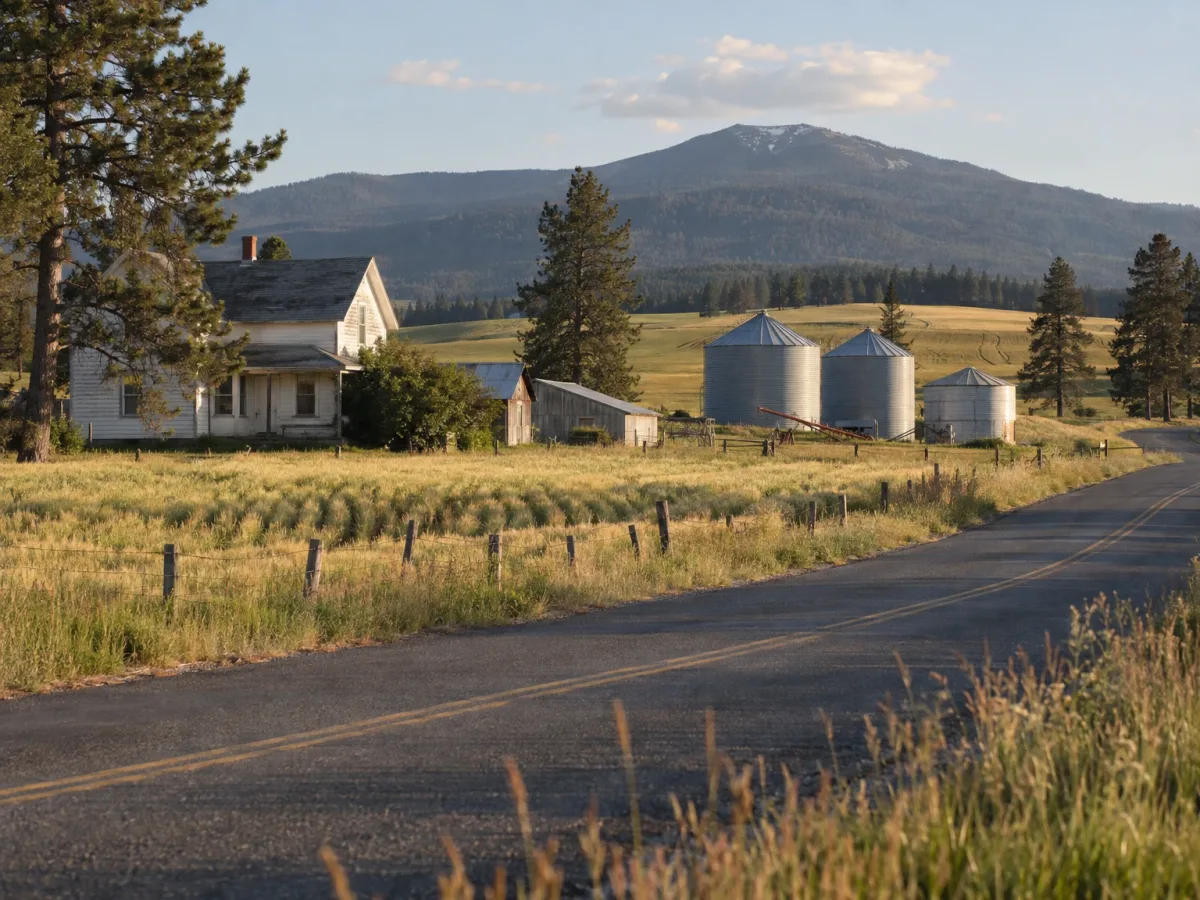
Rural living is common. The state estimates 169,635 people in unincorporated Spokane County in April 2026, about three in ten of the county's 570,600 residents, up from 158,524 at the 2020 Census. Away from city services, farmhouses, manufactured homes and newer houses on acreage each call for a different kind of system.
Share of homes by year built. Source 7.
Towns we serve here
Spokane County questions
Is radon only a problem in Spokane and Spokane Valley?
No. In the state's tract data the tracts within the Mead, Colbert and Chattaroy ZIPs run from 39% to 57% of tests at 4.0 pCi/L or more, and the Deer Park tracts from 42% to 57%. Rural ground is not safer by default.
Why did Spokane County test so high in the early 1990s?
USGS pointed to two causes: the city and its eastern suburbs sit on highly permeable glacial outwash, and the granite hills to the north hold numerous uranium occurrences. In the 1991–92 survey, 59% of 449 county homes were above 4 pCi/L.
Which electric utility will run my fan?
It depends on the address, since five utilities split nearly all of the county. At their 2026 rates a 60-watt fan costs roughly $33 a year at the cheapest and $76 at the dearest.
Do I get the fan permit from the city or the state?
Inside Spokane city limits, from the city; everywhere else in the county, from Washington L&I. The starting price covers it in both cases.
Is there a local radon program or free kit?
The Spokane Regional Health District has no radon program. The Washington State Department of Health mails free kits while supplies last, and the regional clean air agency points to hardware-store kits.
How many homes in the county have been tested?
Few in any given year. In 2018 about half a percent of the county's housing units had a radon test reported to the state.
ZIP codes: 99206 · 99212 · 99027 · 99025 · 99016 · 99030 · 99012 · 99031 · 99005 · 99003 · 99021 · 99018 · 99039 · 99009
Sources for Spokane County (29)
- U.S. Geological Survey: Geologic Radon Potential of EPA Region 10, Washington chapter (Open-File Report 93-292-J)
- Washington Tracking Network (WA Dept. of Health): Radon test results by county, 1990–2020
- Washington Tracking Network (WA Dept. of Health): Radon test results by census tract, all years
- Washington Tracking Network (WA Dept. of Health): Housing tested for radon by county, 2018
- U.S. Geological Survey: Estimated use of water in the United States, county-level data for 2010
- HistoryLink.org: Spokane County, Thumbnail History (Essay 7686)
- U.S. Census Bureau: American Community Survey 2020–2024, Spokane County (tables B25034, B25035, B25024)
- HistoryLink.org: Millwood incorporates on October 26, 1927 (Essay 23278)
- The Spokesman-Review: Then and Now: Greenacres, Washington (Jan. 6, 2020)
- The Spokesman-Review: Then & Now: Otis Orchards (April 22, 2013)
- HistoryLink.org: Rockford incorporates on June 18, 1890 (Essay 23364)
- Washington State Office of Financial Management: April 1, 2026 population of cities, towns and counties
- U.S. Energy Information Administration: Form EIA-861 annual electric power industry report, 2024 data
- Modern Electric Water Company: Rate schedule (effective April 1, 2026)
- Vera Water and Power: Policy 400, rates, charges, tariffs and fees (June 17, 2026)
- City of Cheney: Electric rates and charges for services, 2026 (Resolution F-436)
- Inland Power & Light: Residential rates (effective April 1, 2026)
- Avista Utilities: Calculating your residential electric bill, Washington (effective October 1, 2026)
- City of Spokane: Development fee schedule 2026
- Washington L&I: Residential electrical fee worksheet, July 2026
- Spokane County Building & Planning: Building design criteria
- Washington Administrative Code 51-51-60101: Appendix F, radon control methods (Table AF101(1))
- Washington L&I: City electrical permits and inspections
- Spokane County Building & Planning: Frequently asked questions
- Washington State Department of Health: Radon
- Spokane Regional Clean Air Agency: It's National Radon Action Month (January 2026)
- Spokane Regional Health District: Programs and services
- Spokane Regional Health District: Drinking water (private wells)
- U.S. EPA: What is EPA's action level for radon?
Find your number in Spokane County.
48-hour test from $195. Mitigation from $1,295 with the post-test included.