
Radon Water Treatment for Private Wells
Radon dissolved in well water escapes into the air at every shower and tap. We start with an indoor air test, send a well sample to a lab, and design and install aeration where the water result runs high.
Or call (509) 278-2215
Who should think about water radon
Radon in water is a groundwater question, so it concerns homes on their own well above all. In 2010 a sizable share of residents in both counties supplied their own water, mostly from private wells.
If your water comes from a city or district system, EPA’s advice is to ask the supplier about radon. On a private well the owner decides what gets tested, and the Spokane Regional Health District already points to uranium, arsenic and, in parts of the northeast West Plains, PFAS.
- Air test first, since air radon is usually the larger exposure
- Referral to an accredited lab for radon and uranium in water
- Aeration system design and install for high water radon
- Referral to a treatment specialist for uranium
How a water radon job runs
- STEP 1
Test the air first
We start with an indoor air test on the lowest lived-in level. Maine’s health agency tells well owners to have an air result in hand before they decide on water treatment.2
- STEP 2
Send a well sample to a lab
Radon in water needs its own sample bottle and a lab that runs that analysis. The sample goes to an accredited drinking water lab, and the same order can include uranium and arsenic.
- STEP 3
Compare the two numbers
With EPA’s ratio of about 10,000 to 1 between water and air, the two results show whether the well or the soil under the house is the main source.3
- STEP 4
Size the aeration unit
The design starts from the lab value, the peak flow your household draws and the floor space near the pressure tank. The repressurization pump is chosen to match that flow.10
- STEP 5
Install where the water enters
The unit treats the whole supply before the first branch line, so showers, laundry and every tap get treated water. A vent pipe carries the stripped radon outdoors.1
- STEP 6
Retest the water and the air
After the system has run, a new lab sample from a kitchen tap shows how much radon it removes. A fresh air test shows what still reaches the rooms.
- STEP 7
Hand uranium to a specialist
Aeration leaves uranium in the water. If the lab finds 30 µg/L or more, we refer you to a water treatment specialist for treatment at the tap.8
What sets the price
Water treatment has no list price on this site. We quote it after the lab result and a visit to the spot where the water line comes into the house.
Five things move the number: how high the radon is, the peak flow the house needs, the room around the pressure tank, the route for the vent pipe and the new electrical circuit. Water high in iron or manganese can also need pre-treatment, because those minerals can clog an aeration unit.
A high air result is a separate soil-gas job, and the cost estimator covers that part.
A referral to a certified lab for the water test, a look at where the water line enters the house, and a quote once the result is in.
Air first, then water
For most homes the ground, not the well, supplies most of the radon indoors. By EPA’s estimate, household water accounts for roughly 1 to 2 percent of the radon in a home’s air.
Water can still matter in a single house. At EPA’s ratio, a well at 40,000 pCi/L would add about 4 pCi/L to the air on its own. There is also no federal limit to measure a well against: EPA proposed one for community water systems in 1999, never made it final, and does not regulate private wells.3, 4
What an aeration unit needs in your house
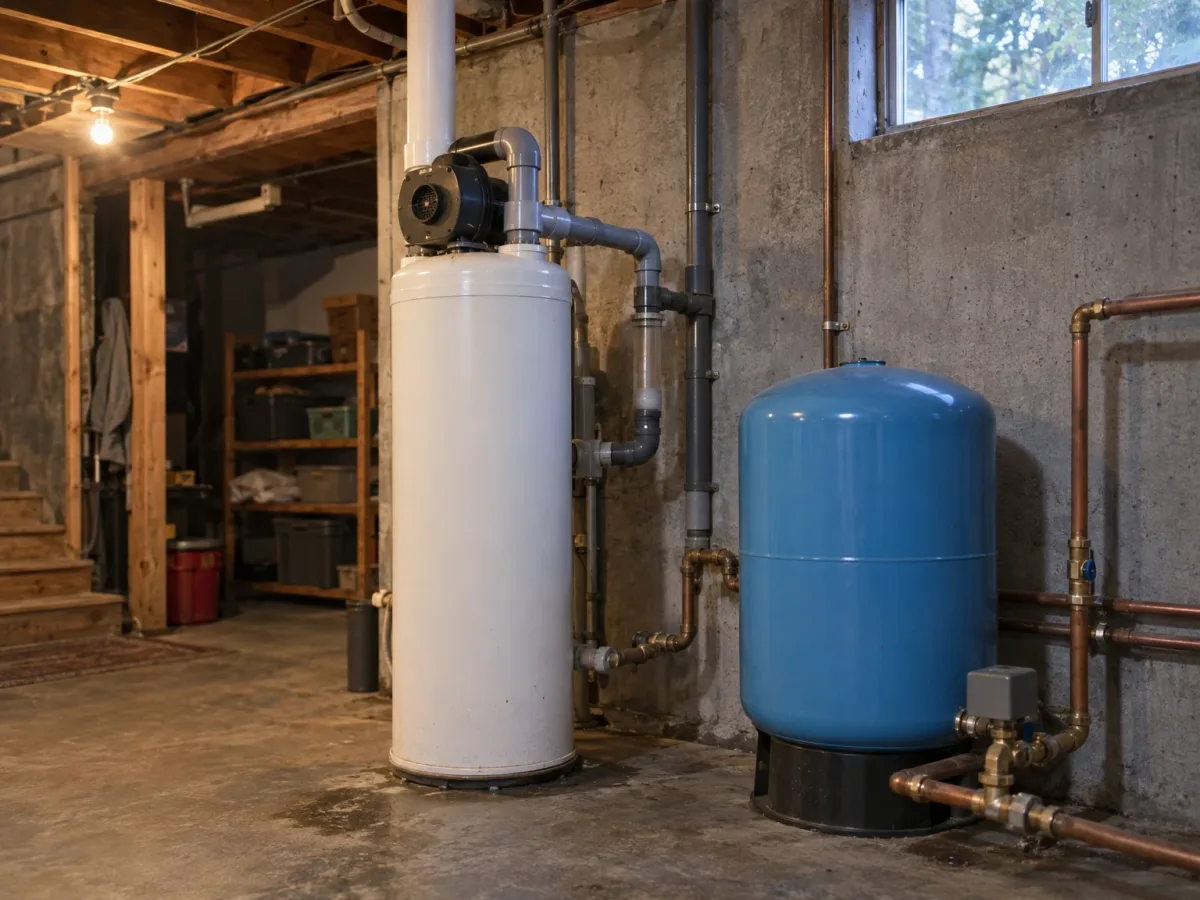
An aeration unit is a tank that bubbles or sprays air through the water and blows the released radon outside. The treated water collects in that tank, so the unit needs its own pump to push it back into the plumbing. Plan for these before the install:10, 11, 1, 12
- Floor space for the tank; one common model measures 35 by 34¼ by 22 inches
- A dedicated 20-amp circuit for the blower and pump
- A repressurization pump with a small pressure tank
- A vent pipe that carries the radon outdoors
- Pre-treatment if the water is high in iron or manganese
- Cleaning once a year, which EPA lists as part of the upkeep
Uranium needs a different fix
Uranium is a dissolved metal, not a gas, so an aeration unit leaves it in the water. Spokane County is one of the counties where Washington’s Department of Health asks private well owners to test for uranium once.
On the Idaho side, Panhandle Health District’s well guide says to test for uranium when you move in and every 3 to 5 years, to resample any result at 30 µg/L or more, and to treat it at the tap. Idaho’s free private well tests, listed for fall 2026, cover uranium and arsenic, but radon is not on that list.7, 8, 9
Aeration or carbon
EPA lists two whole-house options for private wells. Both treat the water before it reaches the first tap.
| Aeration | Carbon (GAC) filter | |
|---|---|---|
| Typical radon reduction | 95 to 99% | 85 to 95% |
| Suits | Higher radon levels | Moderate levels, around 5,000 pCi/L or less |
| Where the radon goes | Vented outdoors | Builds up in the carbon |
| Upkeep | Cleaning once a year | May need a radiation shield; spent carbon needs careful disposal |
| Upfront cost | Usually higher | Usually lower |
Source 1.
Questions
Do water radon systems work?
Yes, when they are matched to the lab result. In EPA’s table of mitigation methods, aeration cuts radon in well water by 95 to 99 percent and carbon filters by 85 to 95 percent. A lab sample taken after installation shows what your own system achieves.
Will an aeration system change my water pressure?
It shouldn’t if the pump is sized right. Treated water sits in the unit’s tank, so a separate repressurization pump and pressure tank feed the house, and that pump is chosen for your flow. One installation manual puts its pump output at about 70 psi and calls for a pressure regulator where older plumbing can’t take that.
Does an under-sink filter fix it?
Not for radon. EPA says point-of-use devices treat only a small share of the water, such as what you drink, and don’t reduce the risk from radon released by showers, laundry and the other taps. Radon needs whole-house treatment where the line enters. Treatment at the tap does fit uranium, which is a separate problem.
What does a water radon system cost?
We price it after the lab result, since the radon level, your household’s peak flow, the vent route and the electrical work set the cost. EPA notes that carbon filters usually cost less than aeration systems, but the carbon collects radioactivity and may need special disposal.
Should I test the well if the air test is low?
Yes. EPA recommends a radon test of the drinking water for anyone with a private well and doesn’t tie that advice to the air result. A low air reading is good news for the rooms you measured, but it doesn’t show what the water holds. Uranium needs its own test either way.
Does a radon system in my basement fix my water?
No. A sub-slab system draws soil gas from under the floor and never touches the plumbing. Radon dissolved in well water needs treatment on the water line, so a house with high air and high water results can need both systems.
Sources (12)
- EPA, A Consumer’s Guide to Radon Reduction, EPA 402/K-10/005 (2025), p. 15 and table p. 16
- Maine CDC, Treatment Systems: Reduce Radon Levels in Your Well Water (tip sheet, undated)
- EPA, Basic Information about Radon in Drinking Water (archived page, undated)
- EPA, Proposed Radon in Drinking Water Regulation (archived page, 64 FR 59246, 1999)
- U.S. Geological Survey, Estimated Use of Water in the United States, county data (2010), domestic self-supplied population
- Spokane Regional Health District, Drinking Water (Private Wells) (2026)
- Washington State Department of Health, Radionuclides in Drinking Water, DOH 331-056 (2018)
- Panhandle Health District, Well Water Flow Charts (July 2023), uranium p. 11
- Idaho Department of Health and Welfare, Drinking Water and Private Wells (updated September 2026)
- RadonAway, AIRaider 433 & 321 Series specification sheet (Rev. B, 2019)
- R.E. Prescott, Cambridge Water Radon Remover, Installation and Operating Instructions (Rev. August 2020), pp. 3 and 8
- Penn State Extension, Radon in Water (rev. December 2012), p. 3