
Radon Mitigation in Airway Heights, WA
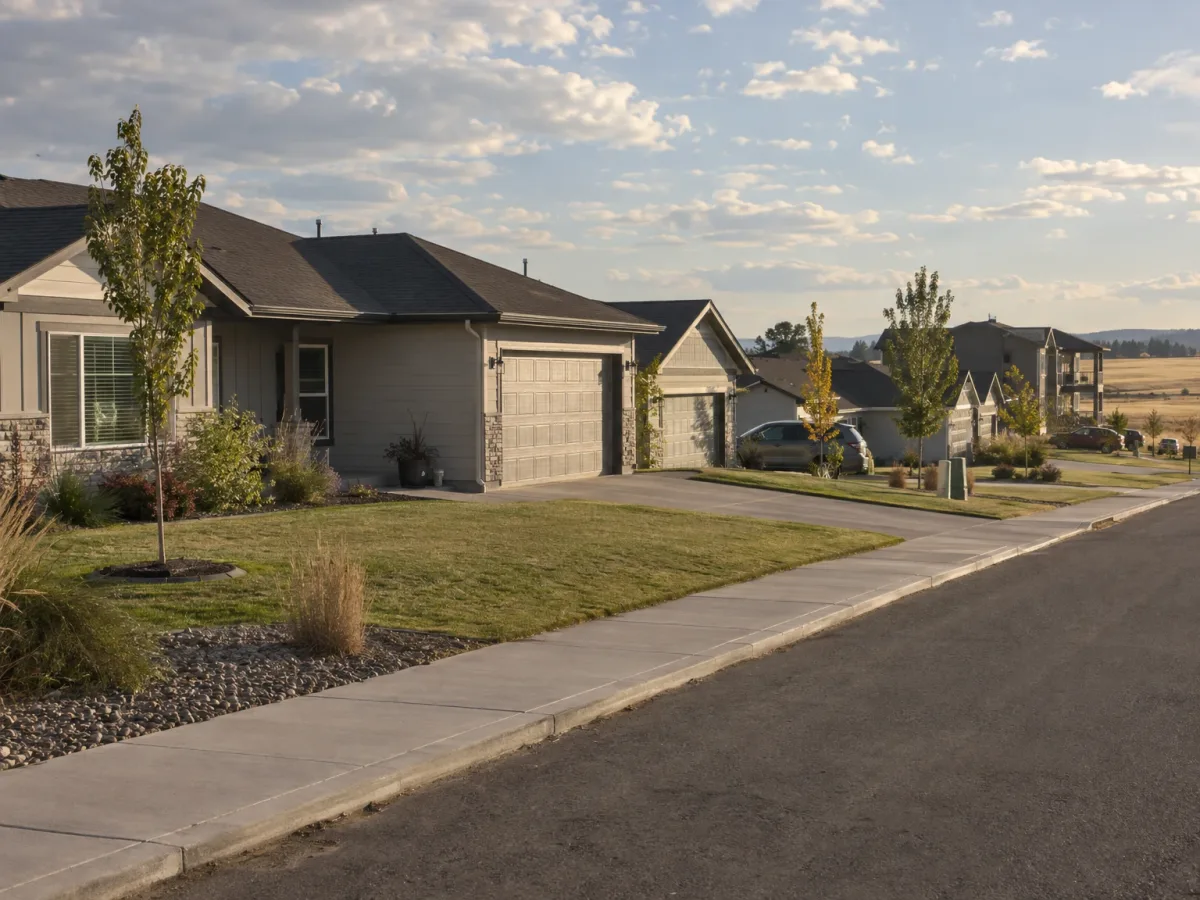
Much of Airway Heights stands on an old flood channel, now buried and packed with loose sand and gravel; one well log went through 349 feet of it without hitting bedrock. About three in four homes were built in 2000 or later. The state's radon record for the city rests on few tests, so a measurement in your own house matters more than usual here.
Or call (509) 278-2215
48-hour test from $195 · Systems from $1,295 · Post-mitigation test included
How it works in Airway Heights
- STEP 1Test
A 48-hour continuous monitor in your lowest living level, under closed-house conditions. Report the same day it comes out.
- STEP 2Look and quote
We check the foundation, run a suction test and plan the pipe route for Airway Heights winters. You get a fixed price in writing.
- STEP 3Install
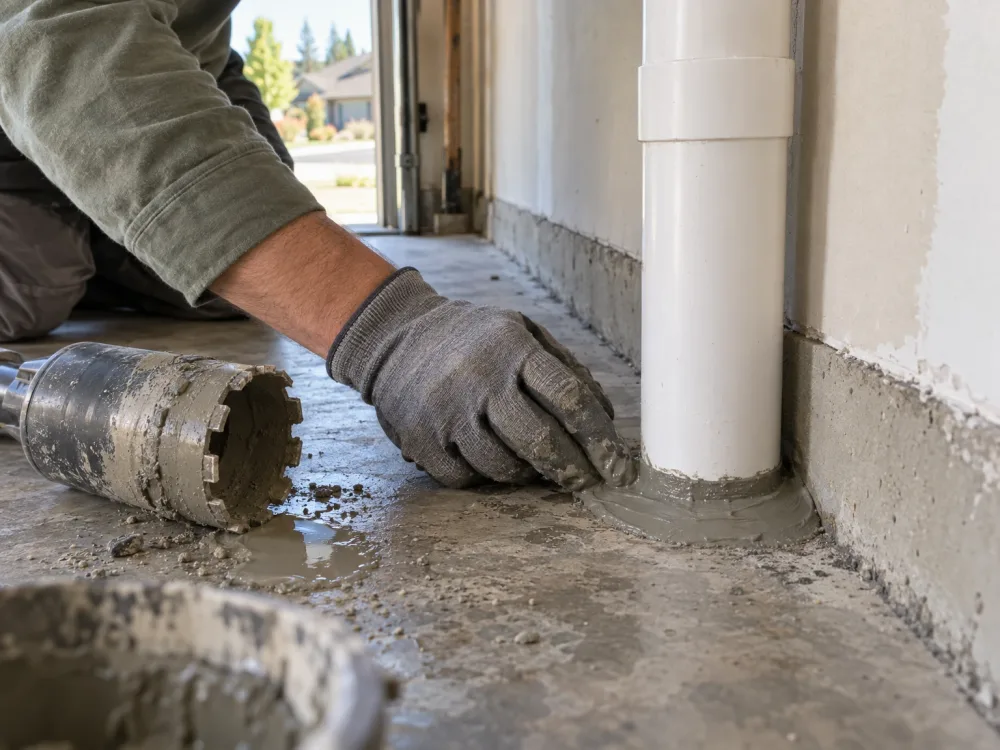
Most systems take one day: suction point, sealing, fan, manometer and the electrical permit.
- STEP 4Re-test
A post-mitigation test at least 24 hours after the fan starts shows the new number. The guarantee is below 4.0 pCi/L.
Radon mitigation cost in Airway Heights
The city says a building's location decides whether Avista or Inland Power supplies it, and the two energy rates differ by more than 5¢ per kWh, so check your bill before comparing fan costs. If a newer house already has a passive radon pipe, adding a fan and a circuit can be most of the job. Manufactured homes and slabs without a pipe start with a pressure-field test.
Starting prices include the electrical permit and the post-mitigation test. Bold: systems common in Airway Heights homes. Estimate your system →
- Spokane County Minor Home Repair (run by SNAP) (radon not named, ask): Repairs of immediate health and safety hazards for lower-income owners outside Spokane city limits. 509-456-7627
for a typical 60-watt fan running around the clock, depending on which utility serves your address. Energy charge only, at 2026 residential rates.
A 20-watt fan costs about a third of that, a 90-watt fan half again as much.
Radon tests, renters and water in Airway Heights
With most homes rented, tenants can test too: the state health department sends free kits to renters as well as owners while supplies last, with 8 to 10 weeks for delivery. Place the kit on the lowest floor you live on, keep the windows closed for the test, and pass a high result to the landlord. When a lease or a sale can't wait, a two-day continuous monitor gives the answer much sooner.
Water is a separate story. PFAS from firefighting foam used at Fairchild turned up in the city's supply in May 2017. Today the city draws on Spokane interties year-round and on its Well 9 in summer, and an eight-tank activated carbon system installed by the Air Force treats the groundwater. The city says that treatment also removes radon from the water, but it does nothing about soil gas coming up under a slab.
Outside the city system, the Spokane Regional Health District has found PFAS in samples from Fairchild east to the Spokane River, north into Riverside State Park and as far south as Assembly Road below I-90. Ecology says private well owners can sign up for testing depending on location. The EPA's line for radon in indoor air is the same everywhere: fix at 4.0 pCi/L, and consider it from 2 up.
Permits and local rules in Airway Heights
The city states that all electrical permits and inspections go through Washington L&I. The fan circuit on a house falls under L&I's $78.80 fee, which covers up to four new or altered circuits as of July 2026.17
Spokane County is one of the state's designated high radon potential counties. The code's radon techniques are meant to resist radon entry and to prepare a house for mitigation in case it turns out to need it.11
City design criteria put frost depth at 24 inches below finished grade and the ground snow load at 39 psf, with a 30 psf minimum roof snow load. Outdoor pipe runs and roof exits are planned around both.18
PFAS and radon are unrelated. The health district reports PFAS in some northeast West Plains wells and advises private well owners to test through an accredited lab; the city's own well water is treated by a carbon system the Air Force installed.19
Form 17, the state's seller disclosure, includes radon gas in its list of environmental concerns. Test results on file make that answer straightforward.21
About 15–20 minutes from our shop.
Airway Heights at a glance
Area figures describe the neighborhood, not your home. Only a test tells you your number. Sources are listed at the end of this page.
A buried flood channel under the West Plains
Airway Heights sits on the flat West Plains, where the city's plan describes thin topsoil and basalt outcrops in many places. Under much of the city, though, runs the Airway Heights Paleochannel, a buried Ice Age channel filled with free-draining flood sand and gravel. It is at least 255 feet thick near three of the city's wells. Outside the channel, the same flood deposits rest on fairly shallow basalt.
State geologic mapping shows what that sand is made of: mostly granitic and metamorphic grains carried in from the east, mixed with local basalt. The U.S. Geological Survey says flood, lake and wind-blown sediment derived from more uranium-rich rock in northeast Washington and north Idaho carries most of the region's uranium, while the basalt itself is generally low in it. Deeper down, a buried ridge of ancient metamorphic and granitic rock runs northeast beneath Fairchild Air Force Base and the northwest part of the city.
How much radon that ground gives off is poorly measured. The one census tract covering most of ZIP 99001 shows 9.8% of reported tests at or above 4.0 pCi/L, but that rests on just 6 high results out of roughly 60 tests. Across Spokane County the figure is 47.0%. A sample that small can swing either way, so treat the city figure as a placeholder, not a verdict.
of flood sand and gravel in one Airway Heights well log, with no bedrock reached6
From 1946 plats to a decade of apartments
Settlement began in 1942, when Carl and Flora Lundstrom bought land beside the new air depot that became Fairchild Air Force Base. The first three subdivisions were filed in 1946, and the town incorporated in 1955 with about 400 residents. For decades mobile homes made up a large part of the housing, between 31 and 48 percent of all units from 1980 to 2010.
Then the housing count nearly doubled between 2010 and 2018, driven by duplexes and apartments, which went from 318 units to about 1,630, plus a 2012 annexation that brought in 838 units. Of the 4,483 housing units the state counted in April 2026, more than half (2,432) were in buildings with two or more units, and mobile homes and other special units still numbered 526. About three in ten occupied homes are owner-occupied.
The population count includes about 2,000 people in group quarters, mainly the Airway Heights Corrections Center; the housing numbers do not. For radon, the young housing stock helps: Spokane County's code, in its current form since July 2007, calls for radon control methods in new houses, and those methods prepare a house for a fan if a test calls for one. Look for a labeled pipe in the garage, a closet or the attic.
Share of homes by year built. Source 3.
Airway Heights questions
The state's figure for Airway Heights is 9.8%. Is radon low here?
The data are too thin to say. It comes from one census tract with only 6 results at or above 4.0 pCi/L, while the county as a whole runs at 47.0%. A two-day test answers the question for your house.
Is radon connected to the PFAS found on the West Plains?
No, they are separate problems. The PFAS traces to firefighting foam and other sources at Fairchild, the airport and a county fire station, while radon comes from the ground itself, and each needs its own test.
Which utility runs my fan, and what will it cost?
Avista or Inland Power, depending on where your building sits in the city. At 2026 rates a 60-watt fan costs about $76 a year on Avista and about $47 on Inland Power.
Does Airway Heights issue the electrical permit itself?
The state does. The city says Washington L&I handles all electrical permits and inspections, and the $78.80 fee for a house is built into the quote.
I rent. Can I still test?
Tenants are eligible for the state's free kit program. If the number comes back high, give your landlord a copy.
My house was built in 2015. Does it need a test?
It does. Spokane County's code prepares new houses for a fan, but the passive features alone don't guarantee a reading below 4.0 pCi/L.
ZIP codes: 99001
Sources for Airway Heights (24)
- Washington Tracking Network (WA Dept. of Health): Radon test results by census tract, all years
- Washington Tracking Network (WA Dept. of Health): Radon test results by county, 1990–2020
- U.S. Census Bureau: American Community Survey 2020–2024, Airway Heights city (tables B25003, B25034, B25035, B26001)
- Washington State Office of Financial Management: April 1 official population and housing estimates, 2026
- City of Airway Heights: Comprehensive Plan, Chapter 2, Community Profile
- GeoEngineers for the City of Airway Heights: Alternative Groundwater Supply Assessment (March 2021)
- Washington DNR, Geology and Earth Resources: Geologic Map of the Airway Heights 7.5-minute Quadrangle (Open File Report 2004-1)
- U.S. Geological Survey: Geologic Radon Potential of EPA Region 10, Washington chapter (Open-File Report 93-292-J)
- City of Airway Heights: Comprehensive Plan, Chapter 5, Housing
- Washington Administrative Code 51-51-60101: Appendix F, radon control methods
- Washington Administrative Code 51-51-60103: Appendix F requirements (AF103)
- City of Airway Heights: Local utilities
- Inland Power & Light: Residential rates (effective April 1, 2026)
- Inland Power & Light: New federal spill surcharge begins July 1, 2026
- Avista Utilities: Calculating your residential electric bill, Washington (effective October 1, 2026)
- City of Airway Heights: When is a permit required?
- Washington L&I: Residential electrical fee worksheet, July 2026
- City of Airway Heights: Geographic design criteria (rev. 02/2024)
- Spokane Regional Health District: PFAS in the West Plains
- City of Airway Heights: Water quality information
- Revised Code of Washington 64.06.020: Seller disclosure statement
- Washington State Department of Health: Radon
- Washington State Department of Ecology: West Plains PFAS
- U.S. EPA: What is EPA's action level for radon?
Find your number in Airway Heights.
48-hour test from $195. Mitigation from $1,295 with the post-test included.